How Mary Cassatt Reimagined Motherhood in Art
2026-05-05 · 3 min read
My dearest incurable humanist, With Mother’s Day approaching, I thought why not write about motherhood in art, and what better way to do so than with Mary Cassatt. Born in Pennsylvania in 1844, Cassatt came from a family with the means to support her ambitions, and that privilege gave her a kind of…
My dearest incurable humanist,
With Mother’s Day approaching, I thought why not write about motherhood in art, and what better way to do so than with Mary Cassatt. Born in Pennsylvania in 1844, Cassatt came from a family with the means to support her ambitions, and that privilege gave her a kind of access that many women artists of her time did not have. But it did not make the path simple. For a woman to become a professional painter in the 19th century was still to push social norms. Cassatt enrolled in the Pennsylvania Academy of the Fine Arts as a teenager, then left for Paris, which was the center of the art world.
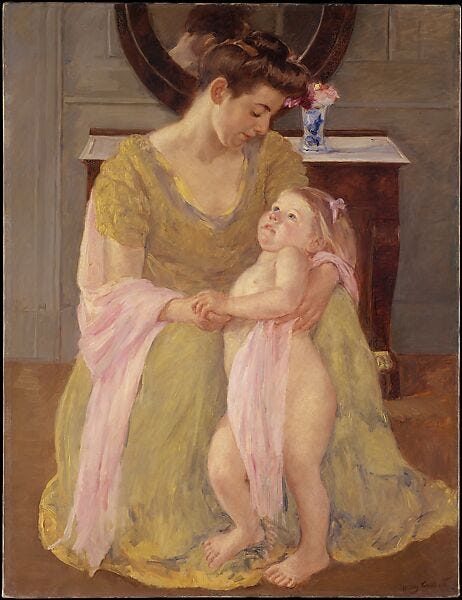
She was no stranger to Paris as she had lived there as a child with her parents, and spent time in Germany as well, learning both languages. This may have eased the transition, but being away from home still must have been difficult, especially in a time before FaceTime or even email.
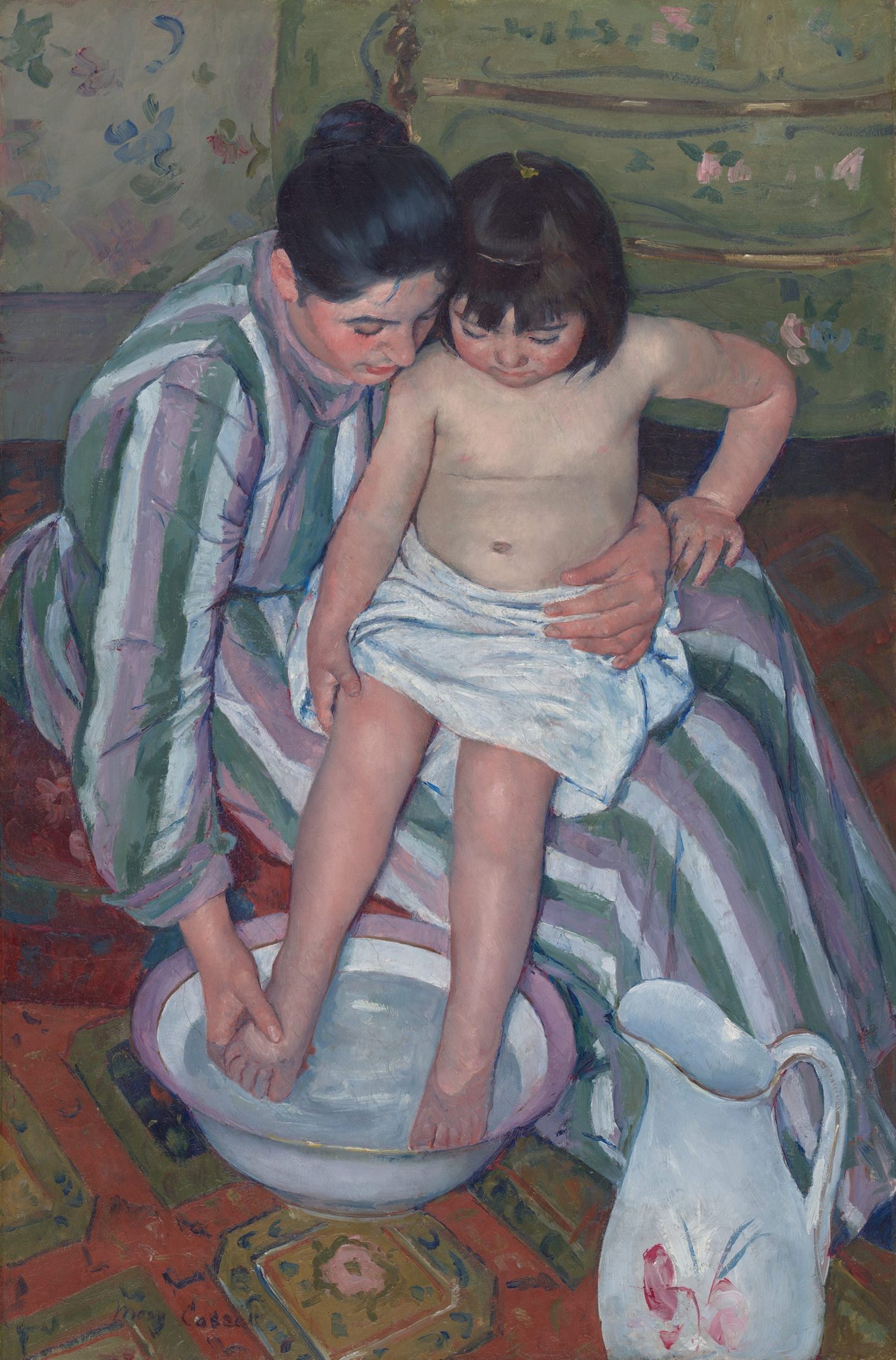
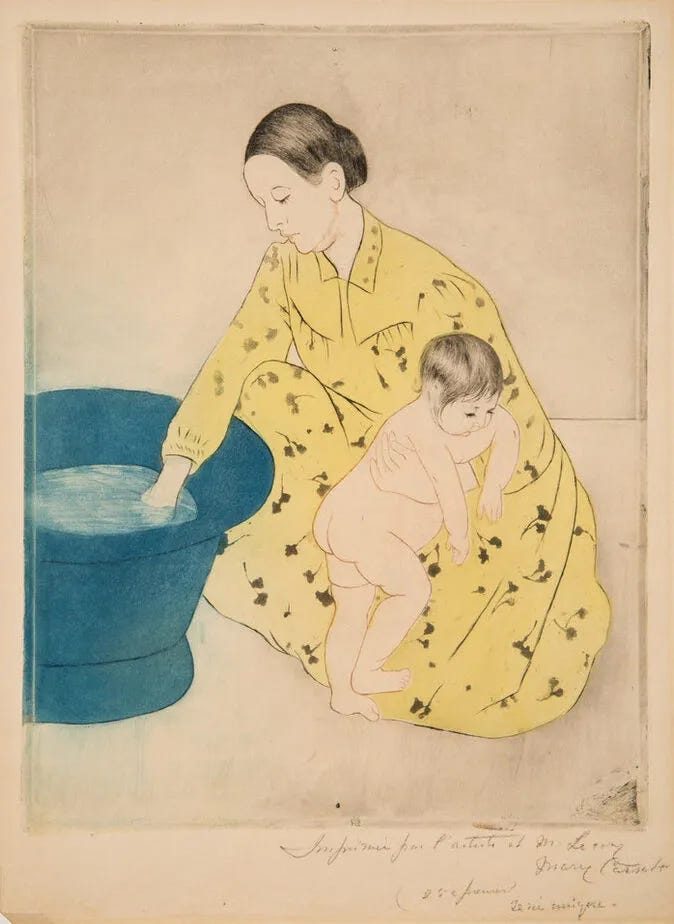
Cassatt found her place among the Impressionists after meeting Edgar Degas, with whom she became lifelong friends. A fun fact is that she is the only American painter to be a part of the group. Yet, as you may know, Impressionists famously started to paint en plein air (in the open air) rather than in a studio; and while they captured the fleeting moments of modernity in the rapidly transforming 19th century Paris, she focused on the domestic sphere. For a woman artist then, that world was the place from which she could work, observe, and think with clarity. Cassatt unequivocally transformed this already exhausted subject matter. She reworked an iconography long associated with Religion and the Virgin Mary and turned it to modernity - showing what real women of the time were experiencing. Even when she wasn’t a mother, she thoroughly captured ordinary acts: washing a child, sewing near a daughter, holding a sleeping baby. In works such as The Child’s Bath, the relationship is built through gesture; a hand steadying a foot, a cheek brushing a shoulder, an arm enclosing a child with assurance.
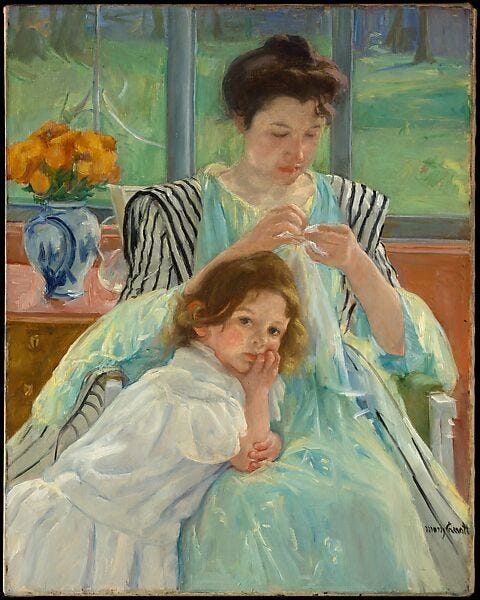
This intimacy is central to Cassatt’s oeuvre. In Young Mother Sewing, (one of my favorites), the mother remains absorbed in her task while the child presses seemingly bored waiting. Cassatt depicts how motherhood is often made in small day-to-day acts. Another modern trait of her work is how Cassatt paints mothers as thinking people. Her women read, sew, converse, and sit in reflection. They are not reduced to function, even as they are caring for children. In this way, Cassatt expands the image of motherhood beyond nurture alone. She suggests that the mother is both caretaker and individual — a person with an inner life.
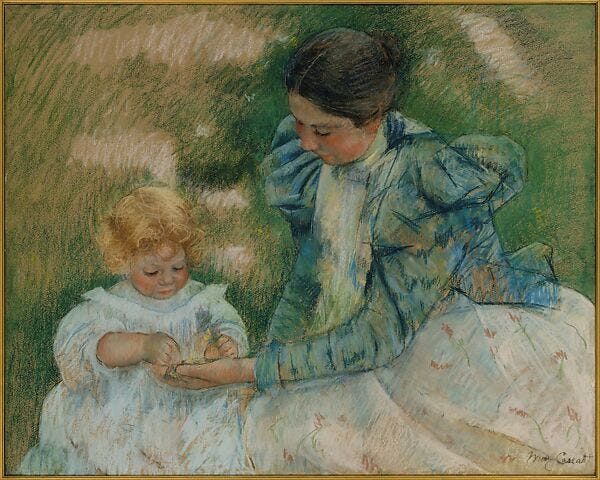
Her formal innovations deepen this as well. Cassatt’s compositions often bring the viewer unusually close to the figures, flattening space and emphasizing pattern, color, and surface. This proximity makes the scenes feel as if we have stepped into a private room without quite being noticed. In her late work, including pastels such as Mother and Child (Baby Getting Up from His Nap), she used bold color, loose strokes, and a modern sense of flatness.
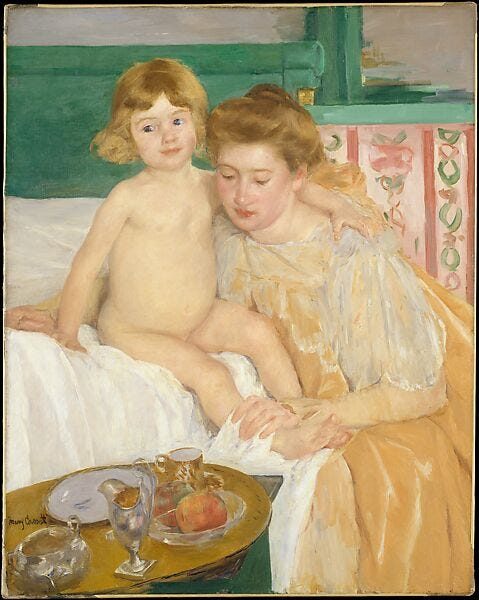
Moreover, she was also deeply influenced by Japanese prints, which helped shape her use of cropped composition, strong outlines, and decorative surfaces.
So Happy Mother’s Day to all mothers, mother figures; the young, the old, the soon-to-be, the trying-to-be, the should-be, the ones who are no longer with us, the ones balancing work, family, care, loss, and hope. Cassatt’s work lingers with the reality that motherhood is not perfect but loving.
Until next week!
(Read by the author. Theme song, The Incurable Humanist, by Carlos Escalona Cruz. All Rights Reserved)