Thoughts on Impermanence
2025-09-02 · 3 min read
My dearest incurable humanist, We live in a world where everything is fleeting. And yes, in a way, this has always been the case. But I mean it in the sense of the immediacy in which everything happens today. The constant scrolling on social media, the lack of attention, you know what I mean. Even…
My dearest incurable humanist,
We live in a world where everything is fleeting. And yes, in a way, this has always been the case. But I mean it in the sense of the immediacy in which everything happens today. The constant scrolling on social media, the lack of attention, you know what I mean. Even as I am writing this, I have lost track of how many times I have already opened a new tab, checked my phone, texted someone, and gotten up to get a glass of water. I think about where we are headed as a society, glued to screens and addicted to instant gratification. But then I also remember that somehow this isn’t all that new.
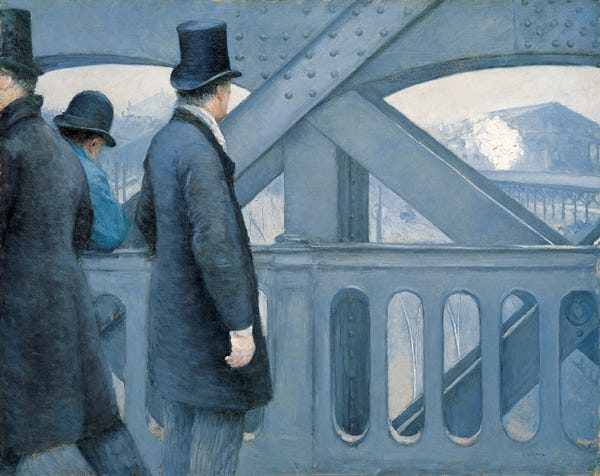
Baudelaire wrote about the flâneur in his essay The Painter of Modern Life, 1863. He describes the flâneur as a passionate spectator of the modern landscape of 19th-century Paris. Gustave Caillebotte's On the Pont de l’Europe, 1876–77, is a great example of this. Caillebotte’s protagonist is standing on an iron bridge staring at the trains and smoke below. The scene depicts both the industrial transformation of Paris and the flâneur’s experience. I guess in a way, just as the flâneur strolled through Paris, we scroll through feeds. Both responses to feeling the world will transform and leave you behind.
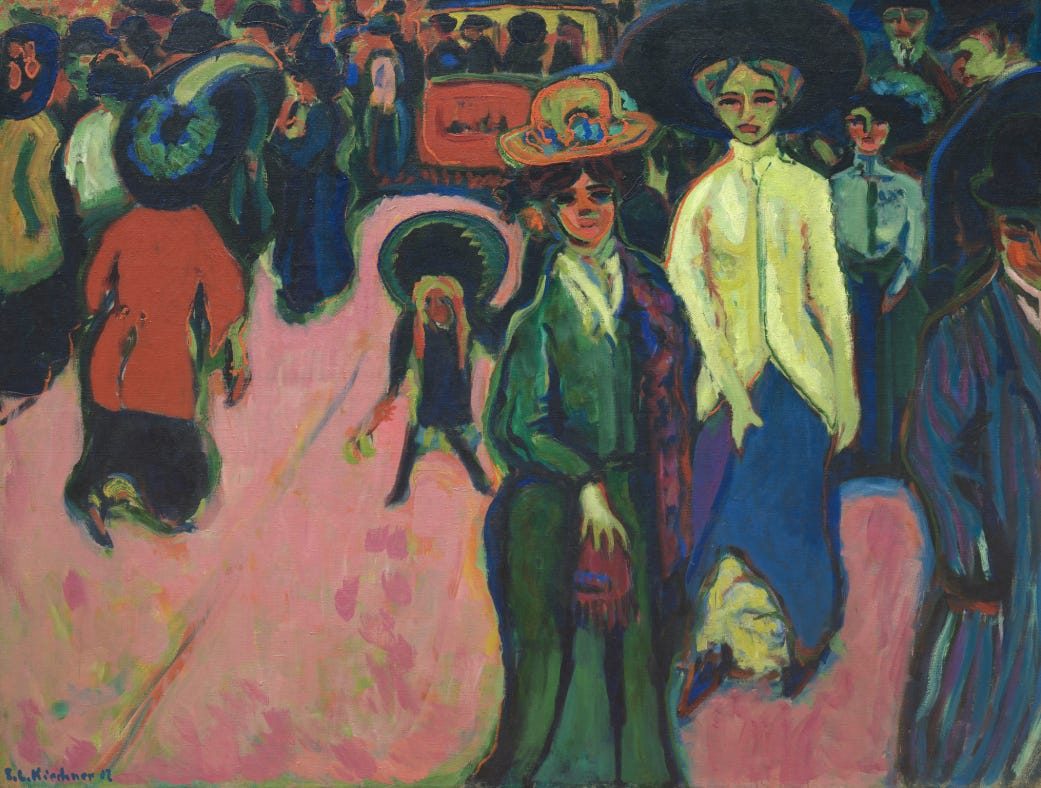
My mind also wanders inevitably to one of my all-time favorite paintings: Ernst Ludwig Kirchner, Street, Dresden, 1908. Through color, distorted figures, and expressive brushstrokes, he portrays the disconnection and alienation of modernity.
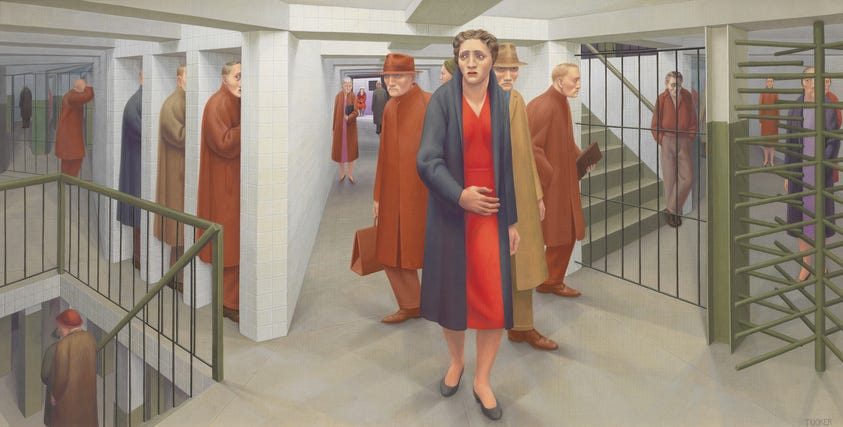
George Tooker tackles something similar in The Subway, 1950, with commuters in the station. The painting captures the psychological toll of modern life in a city, the existential anxiety of 20th-century urban life.
I also feel that this sense of how everything is fleeting is tied to my migration experience. I have had seven addresses since 2019: my childhood bedroom in Caracas, Apt 3J in Manhattan, three apartments in Mexico City, 36th and Madison, and now uptown. In Mexico City, I left most of my things in plastic storage boxes, stacked in my bedroom. Another layer of how momentary it all felt and how I knew that at any moment I would have to pack up again, so why go through the trouble of settling to begin with?
The idea of the fleeting moment echoes in my mind every day. Somehow, everything feels ephemeral: work, homes, even the way we think. So, it’s easy to let relationships fall into the same category. But I want meaningful, long-lasting friendships, to grow old with my husband, and to stay close to my family. In the speed of it all, this seems like the only thing that can truly make a difference in our existence.
(Read by the author. Theme song, The Incurable Humanist, by Carlos Escalona Cruz. All Rights Reserved 2025.)