How Migration Shaped Wifredo Lam’s Artistic Vision and Legacy
2025-11-18 · 4 min read
My dearest incurable humanist, Last week, I went to MoMA’s Wifredo Lam retrospective When I Don’t Sleep, I Dream and it resonated with me how much migration shaped his work and his world’s understanding. Born in Cuba in 1902, Lam was already an immigrant before birth. His father came from Canton in…
My dearest incurable humanist,
Last week, I went to MoMA’s Wifredo Lam retrospective When I Don’t Sleep, I Dream and it resonated with me how much migration shaped his work and his world’s understanding.
Born in Cuba in 1902, Lam was already an immigrant before birth. His father came from Canton in the wave of Chinese workers who arrived in the late nineteenth century, bringing calligraphy and ancestor worship. His mother was Cuban but had African and Spanish blood.
In 1923, Lam left for Spain on a scholarship to study portraiture at the Real Academia de Bellas Artes de San Fernando in Madrid. Due to the Spanish Civil War, he fled to Paris. There, he fell in love with modernism, flattening paintings and distancing himself from the use of local colors and the academy. Migration put him in contact with different ideas and artists, giving him access to a visual language he couldn’t have developed otherwise. Mother and Child (1939) shows the influence of his newfound friends like Pablo Picasso, Fernand Léger, Georges Braque, Joan Miró, Andre Breton, and others.
With the outbreak of World War II, he had to move once again. Lam had a sojourn in Marseille with a group of intellectuals and artists who were also escaping the war. In that limbo, he began drawing hybrid beings: part human, part plant, part animal. After a stop in Martinique, he settled in Cuba after being away for eighteen years. This arrival was complex. Psychologists call this reverse culture shock. The psychological experience of returning to one’s country of origin after migration involves significant emotional and mental challenges because the home is no longer the same as one remembered or expected. Lam said it was “a moment of great anguish and perhaps great joy.” In this process, he was confronting “all the colonial drama of [his] youth.”
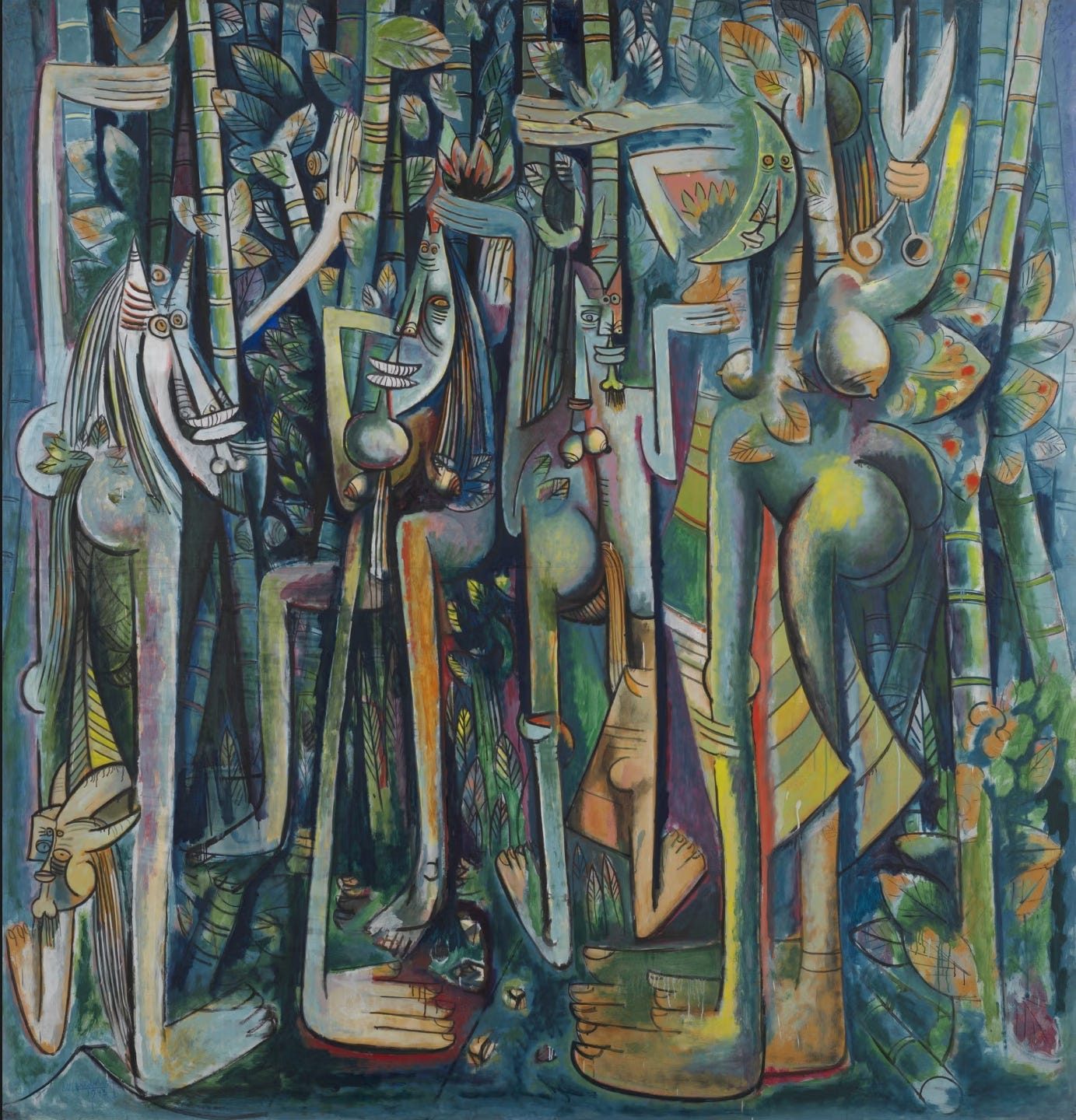
Nevertheless, this marked perhaps one of the most pivotal points in his oeuvre. He was struggling, and with no money yet, Lam believed this was a period of great stimulation. The artist responded to the environment that surrounded him: Cuba’s flowers, culture, and politics. The Jungle (1942–43) came from this. Instead of a canvas, he used two large pieces of Kraft paper glued together because it was all he could afford. Initially, he sketched with charcoal and then used thin layers of oil paint. This painting is a synthesis of Afro-Cuban culture, European modernist influences, and Cuba’s socio-economic realities. It presents a packed, disorienting assembly of hybrid figures—crescent-shaped faces, elongated limbs, and exaggerated forms—set within a compressed, flat landscape of sugarcane fields, tied to the labor exploitation underpinning Cuba’s economy. Lam critiques the contrast between the island’s colonial and neocolonial structures and the glamorous image of Cuba promoted to tourists, transforming the painting into both a visual and political meditation.
Because of the war, New York had overthrown Paris as the new center of the art world, with the exodus of European artists. Through his Parisian connections, Lam was visible to American audiences: in 1942, Alfred Barr Jr., director of MoMA, visited his studio and purchased a work, and later that year Lam was included in First Papers of Surrealism, an exhibition curated by André Breton and Marcel Duchamp that sought to plant Surrealism in America. Despite the acceptance of his work, Lam never made New York his home. As a Cuban, securing U.S. citizenship was complicated, and his artistic identity was rooted in the European avant-garde. Lam believed that once the war ended, Paris would reclaim its position. In this sense, Lam’s choice reflects both the personal and political dimensions of migration.
Lam spent the next decade moving through the Caribbean, connecting with poets and thinkers of the African diaspora. His friendship with Aimé Césaire became one of the century’s great intellectual partnerships. By the late 1940s, Wifredo Lam’s work had shifted toward abstraction, moving from the vibrant tropical imagery of his early Cuban period to darker palettes, simplified landscapes, and dynamic compositions, as seen in Grande Composition (1949) In 1952, Lam permanently returned to Europe, settling in Paris and later Albissola Marina, Italy, where he entered a late period exploring ceramics, printmaking, and sculpture. He maintained connections with Caribbean intellectual and artistic circles.
Wifredo Lam’s work is timeless and urgently contemporary. It encompasses the layers of migration; the emotional, psychological, and cultural tolls it carries. He lived across continents and amidst historical upheaval, demonstrating how movement shapes identity and creative vision. Lam’s hybrid figures, flat landscapes, and synthesis of cultural motifs demonstrate how migration imprints on consciousness, how leaving and returning alter one’s sense of home, and how art can hold dissonance, grief, and meaning.
Until next week.
PS. You can visit Wifredo Lam, When I Don’t Sleep, I Dream at MoMA in New York through April 11, 2026.