Salvador Dalí’s Surreal Christmas
2025-12-23 · 4 min read
My dearest incurable humanist, In 1934, Salvador Dalí traveled to New York City with his wife Gala, while Europe was already shadowed by the rise of fascism. Manhattan’s commercial speed, spectacle, and boundless optimism captivated him. That year, he painted Allegory of an American Christmas , a…
My dearest incurable humanist,
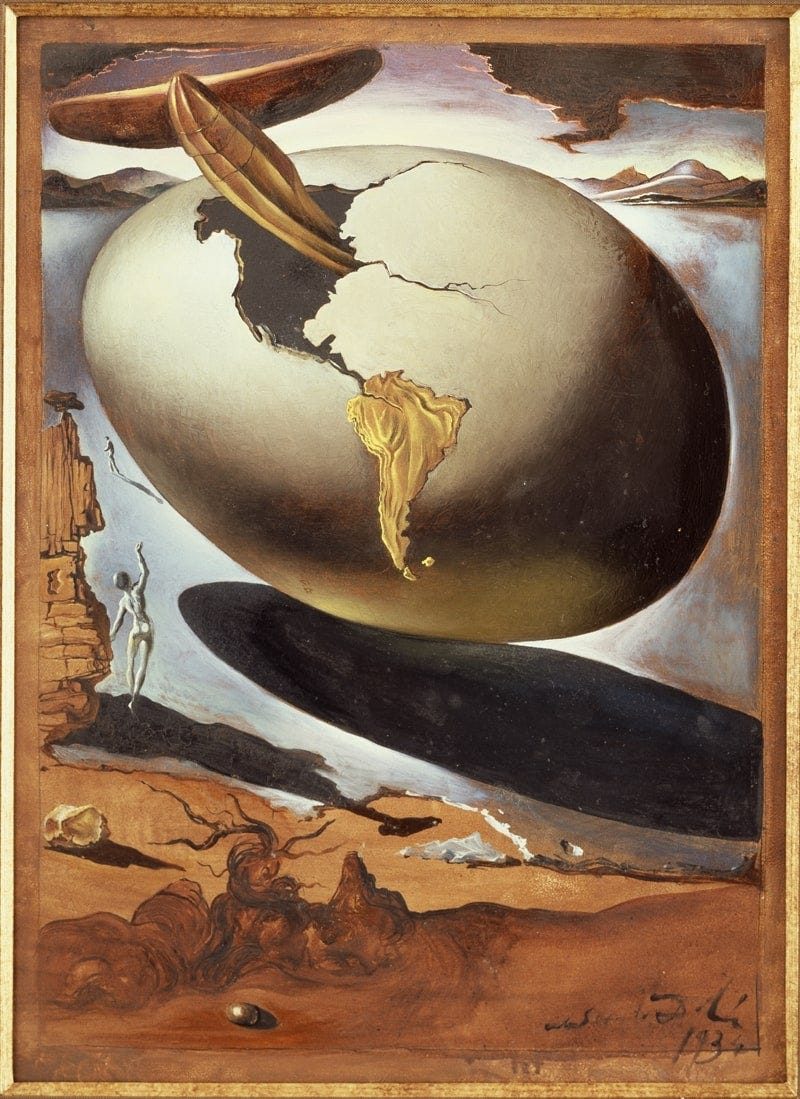
In 1934, Salvador Dalí traveled to New York City with his wife Gala, while Europe was already shadowed by the rise of fascism. Manhattan’s commercial speed, spectacle, and boundless optimism captivated him. That year, he painted Allegory of an American Christmas, a surreal homage to rebirth through the gaze of an immigrant. A colossal egg-globe hovers over a barren blue background, cracked open to birth a golden airplane. Its shape traces the Americas; North as dark void, and South glowing. Dark clouds menace above, yet warmth at the rupture, turning fracture into flight. At the base, a human figure underscores the imbalance of scale between the individual and the mythic promise of the American dream. A secular nativity with modernity hatching from desolation.
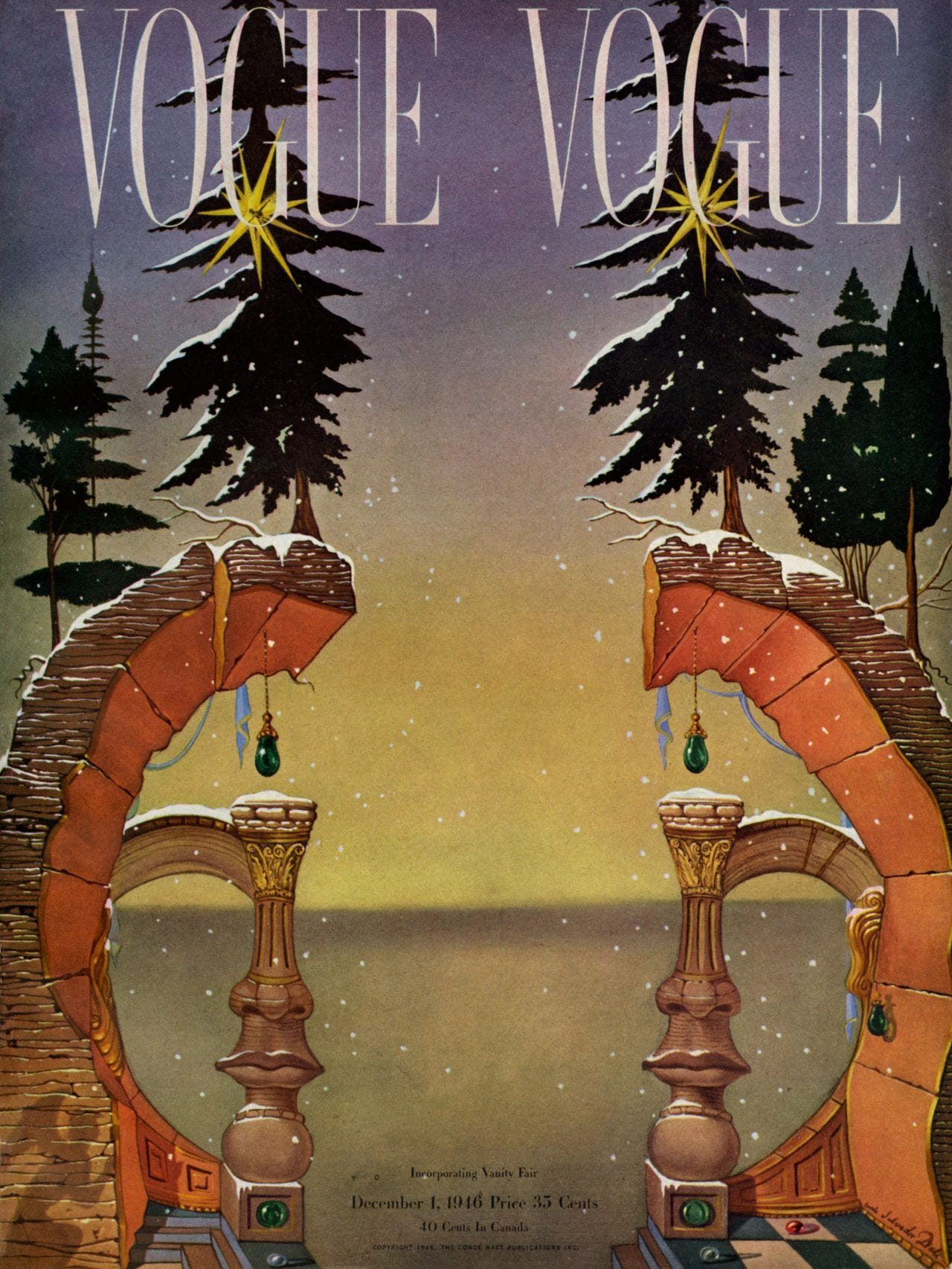
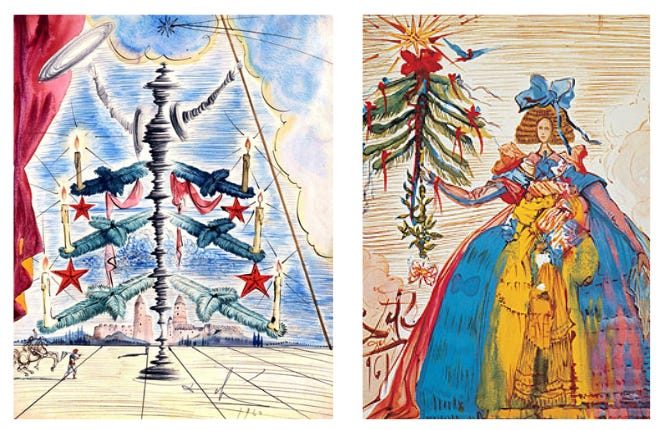
Six years later, in 1940, they fled the Spanish civil war’s aftermath and Nazi threats, arriving in New York where they lived primarily until 1948. He found great success in the US, with a retrospective at MoMA, collaborations with Hitchcock and Disney, window displays at Bonwit Teller, and more. Yet beneath the success ran the loneliness of migration, of reinventing oneself publicly while grieving. His 1946 Vogue cover, Christmas (Noël), presents symmetrical snow-dusted trees. The spiraling columns have ornaments but the space feels empy. It captures immigrant disorientation with holiday symbols adrift, like trees in exile. At first glance it might seem festive, but the cheer melts into the ache of missing home.
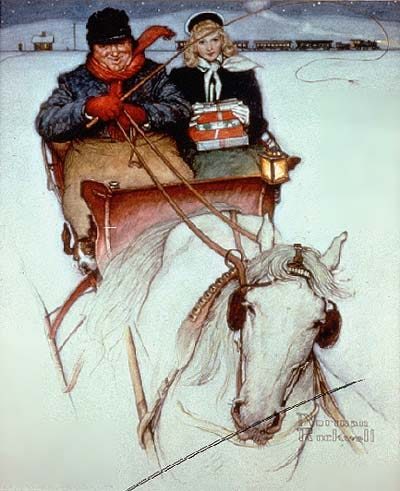
By the late 1940s, Hallmark was shaping festive imagery in the US, attracting renowned artists to collaborate. Norman Rockwell created dozens of traditional Christmas designs for them; defining the vision of American Christmas built on nostalgia, and postwar ideals of family and optimism.
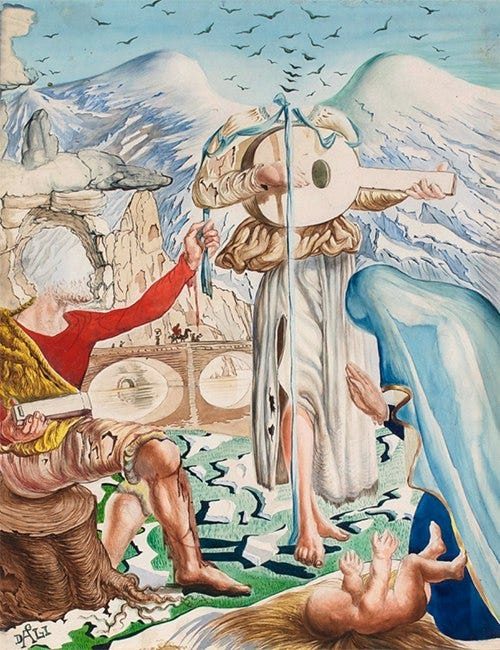
Dalí’s take on Christmas on contrast, was not well received. His first card, The Angel (1947), features a headless angel, dissolving into birds and mountains. Baby Jesus is glowing but featureless, and even the animals seem tense. Customers recoiled and sales failed. Beneath the surrealism lay the unconscious of exile and loss, fundamentally misaligned with a culture that expected Christmas to reassure rather than disturb.
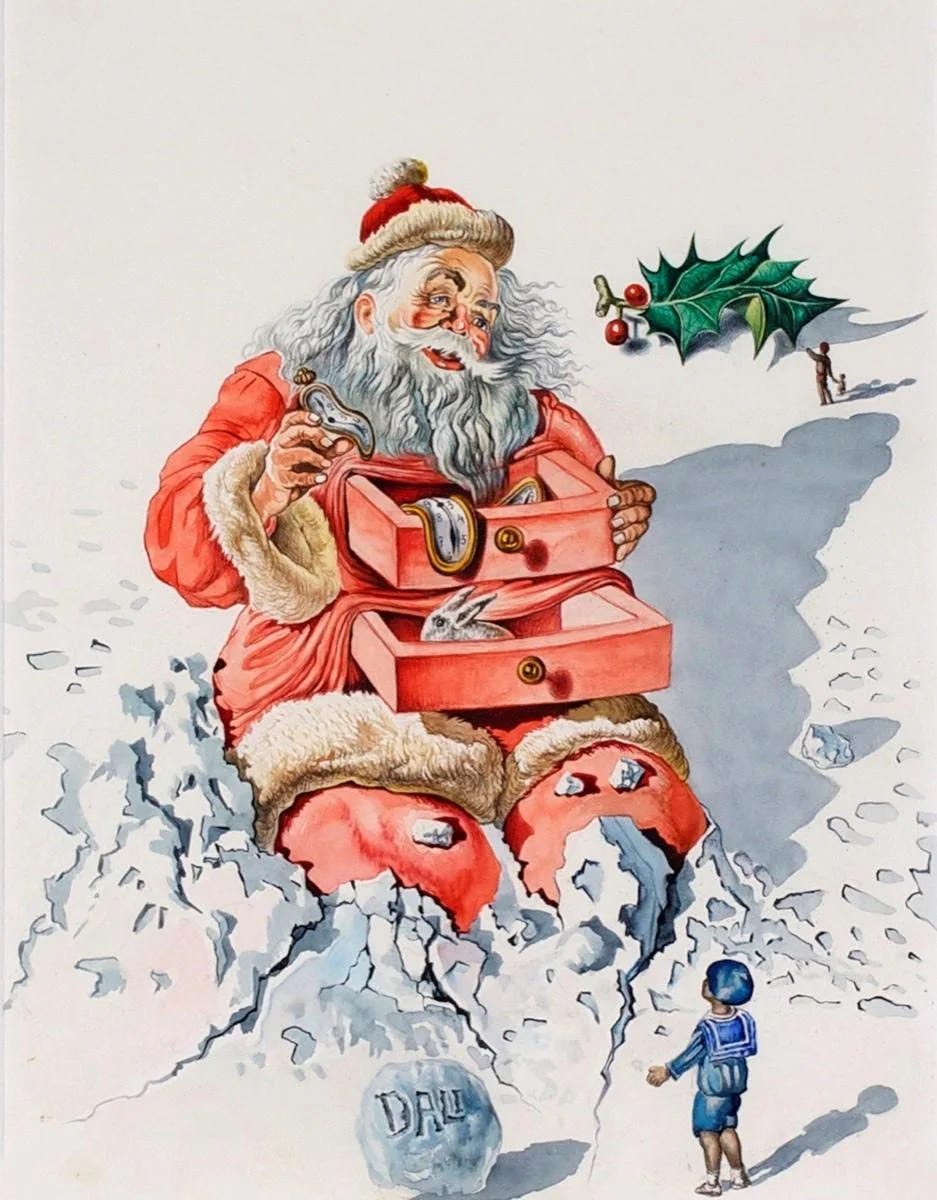
He tried again with Santa with Drawers (1948). In it, Santa erupts from a snowy tundra, his belly punctured by drawers containing melting clocks and a white rabbit. Psychoanalytic symbols smuggled into holiday kitsch. At the bottom, there’s an elf and in the upper right corner, what appears to be a man and child; perhaps migrants? The scale is a metaphor. The colossal Santa a wink to America's grandeur, while the tiny figures confront their newfound reality.
Hallmark purchased it but never released it. They rejected several other designs as “too avant-garde”, too strange. But isn’t that what loss feels like? The holidays are supposed to be synonymous with joy, yet for those far from home or missing someone they are tainted with melancholy.
Surrealism and psychoanalysis were intertwined from the beginning. Breton’s 1924 Surrealist Manifesto drew on Freud, advocating for “psychic automatism”; a method to bypass rational censorship and aim to make the unconscious conscious. Lately I have been thinking how this illuminates Dalí’s Christmas work differently when viewed through the lens of migration. Perhaps unintentionally, his headless angels and melting Santa were his unconscious manifestations of what happens when you celebrate traditions in a foreign country.
After returning to Spain in 1948, Dalí created 19 Christmas cards for Hoechst Ibérica between 1958 and 1976. Unlike traditional Mediterranean Catholic imagery, he did not incorporate Nativity scenes or Wise Men. Instead, he adopted the American Christmas tree, and merged it with Spanish culture; such as transforming a tree into Don Quijote’s silhouette, and incorporating Velázquez’s Las Meninas.
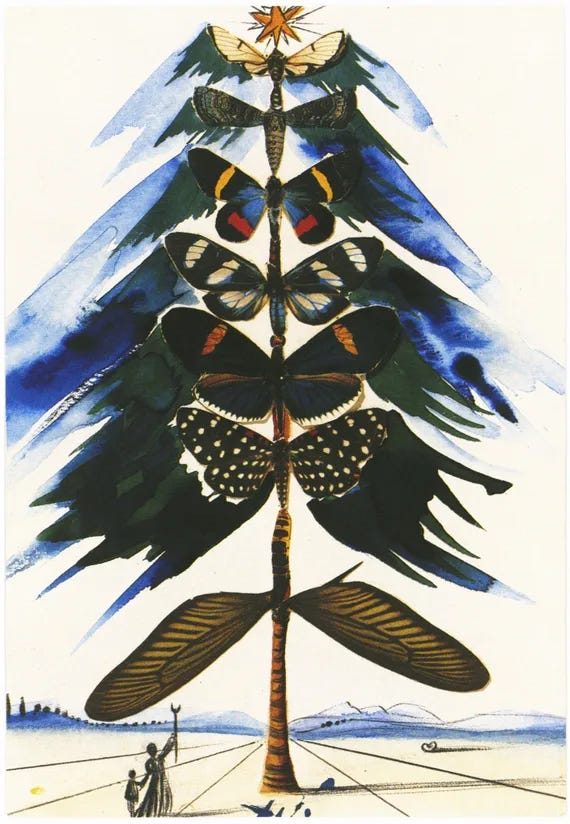
His card, Christmas with Butterflies (1959), showed a Christmas tree dissolving upward into a swarm of butterflies ascending. He later explained it evoked memories of his mother. After her death in 1921, Dalí turned obsessively to Freudian symbols: eggs, wombs, drawers, dissolving bodies. Recurring forms through which his loss became visible.
I’m writing this thinking of you, away from home, or perhaps home but missing someone who’s far or who’s no longer here. Maybe 2025 has felt surreal (pun intended). Maybe you’re exhausted from holding it all together. Maybe Christmas feels like one of Dalí’s rejected Hallmark cards. Wherever you are this season, may you discover that what feels like exile can also be a kind of hatching.
Merry Christmas!
Until next week.