Jagged Little Pill v. ¿Dónde Están los Ladrones?
2025-05-20 · 10 min read
My dearest incurable humanists, I’ve always been an over-thinker. Ever since I can remember, I’ve been obsessed with two albums: Jagged Little Pill (1995) by Alanis Morissette and ¿Dónde Están los Ladrones? (1998) by Shakira . Some critics in the ’90s addressed some similarities, but never with any…
My dearest incurable humanists,
I’ve always been an over-thinker. Ever since I can remember, I’ve been obsessed with two albums: Jagged Little Pill (1995) by Alanis Morissette and ¿Dónde Están los Ladrones? (1998) by Shakira. Some critics in the ’90s addressed some similarities, but never with any real analysis. I’ve had this theory for years, and although there has never been a confession that ¿Dónde Están los Ladrones? is a Latin American response or homage to Jagged Little Pill, I believe it is. Bear with me, read this, and when you are done, tell me I’m right.
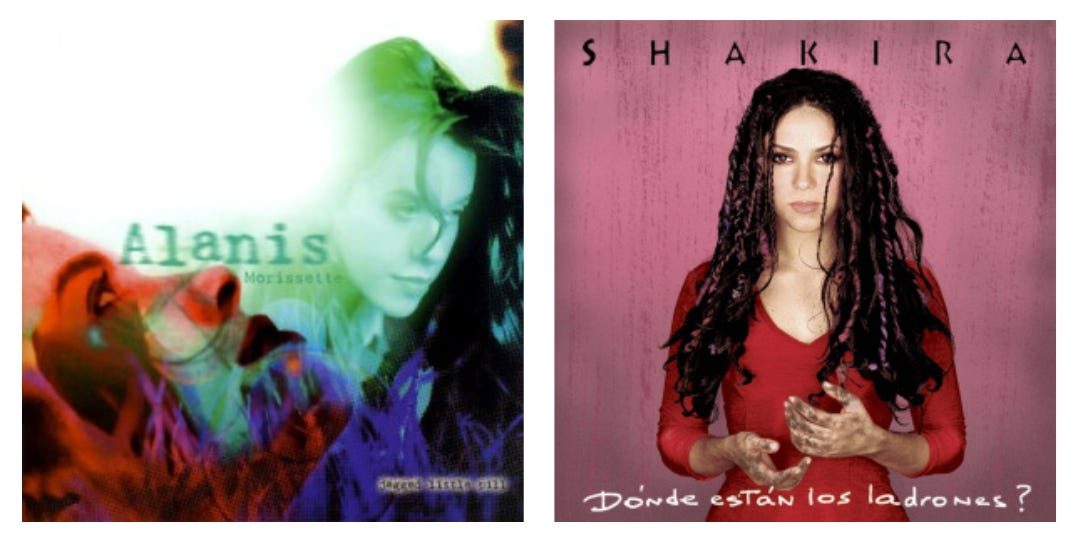
BACKGROUND
Alanis Morissette released Jagged Little Pill after moving to LA to reinvent her sound. She delivered one of the most raw and unforgettable albums ever, earning four Grammys. However, this wasn’t her first record. She had already released Alanis (1991) and Now Is the Time (1992), but those albums were only available in Canada.
In 1998, Shakira released ¿Dónde Están los Ladrones?, her fourth studio album. By then, she was already popular in Colombia and Latin America after the breakthrough success of Pies Descalzos in 1995. That album caught the attention of Emilio Estefan, who invited her to Miami to record with Luis Fernando Ochoa, who had also produced her previous album. This marked a pivotal moment for Shakira.
No matter your generation, the feelings and themes of these albums are universal. The longing, the questions of love and identity are timeless. I was born in ’95, so I discovered Jagged Little Pill later. As a teenager, I navigated my drama and tried to write songs that might capture my truth. Alanis’s songwriting struck me as the most raw, direct, and painfully honest.
On the other hand, ¿Dónde Están los Ladrones? was the first CD I ever owned. I was three and played it nonstop, singing along without understanding half of what I was saying, but I knew every lyric by heart. Shakira was my first obsession, my first ideal. I’d perform her songs for my parents and their friends; and told my mom I wanted to be a lawyer during the day, like my dad, and a singer-songwriter by night, filling stadiums like Shakira (totally doable, right?). But enough kaffeeklatsch. Let’s get to the core.
FACTS
EXHIBIT A. Alanis opens with All I Really Want, a folky track featuring her signature harmonica. Shakira kicks off with Ciega, Sordomuda; a bold, trumpet-driven anthem that blends mariachi influences without abandoning her Colombian heritage and still embracing a broader Latin pop sound. I find it especially compelling how they both open with subtle religious references. Alanis sings, “If only I could meet the maker” (…) “If only I could kill the killer,” hinting at a frustrated search for meaning and justice. Shakira uses language like “exorcizarme de tu voz” and “arrancarme el corazón” (“exorcise me from your voice” and “tear out my heart”).
EXHIBIT B. Moving on to the second track, they both are their hardest-hitting feminist pop anthems. You Oughta Know and Si Te Vas. These songs burn unfaithful men. Alanis sings, “But it was a slap in the face / How quickly I was replaced /And are you thinking of me when you f*** her,” while Shakira fires off, “Si me cambias por esa bruja, pedazo de cuero, no vuelvas nunca más.” (If you trade me for that witch, piece of leather, never come back). Both narrators go after the woman they were left for with sharp sarcasm. Alanis snarls, “Every time I scratch my nails down someone else’s back, I hope you feel it,” while Shakira warns, “Volverás desde tu infierno, con el rabo entre los cuernos.” (“You will come back from hell, with your tail between your horns.”). But underneath the strong surface, there’s pain. What sounds like confidence is a defense, a way of keeping dignity intact after betrayal. That’s what makes these tracks resonate so deeply, they don’t erase the scar.
EXHIBIT C. The third track on both shifts the emotional heat. The connection between Morissette’s Perfect and Shakira’s Moscas en la Casa isn’t shared in themes but in tone and placement. Both are mellow, introspective ballads following the emotional urgency of what precedes them. Perfect tackles the internalized pain of parental pressure. Alanis sings from the perspective of parents with impossible expectations: “Sometimes is never quite enough/ If you're flawless, then you'll win my love.” There’s a slow-burning ache. Shakira’s Moscas en la Casa offers a different kind of stillness shaped by romantic absence. “Mis días sin ti son tan oscuros / Tan largos, tan grises, mis días sin ti.” (My days without you are so dark / So long, so gray, my days without you). It’s a song about the hollow days that follow heartbreak. Neither of them is a centerpiece, but they shape the emotional contour of the albums.
EXHIBIT D. The Fourth tracks; Hand in My Pocket and No Creo stand out as now classics beloved by fans, being declarations of the uncertainty of youth. There’s a kind of self-assured looseness in both tracks. Alanis lists contradictions with grace: “I’m broke but I’m happy, I’m poor but I’m kind” and then lands with that perfect chorus: “I’ve got one hand in my pocket / And the other one is givin’ a peace sign.” Shakira delivers a song that sounds almost lighthearted but is really about self-preservation: “No creo que el mar algún día/ Pierda el sabor a sal/ No creo en mi todavía/ No creo en el azar” (I don't believe that the sea will ever lose its salty taste/ I don't believe in myself yet/ I don't believe in chance.) There’s skepticism, defiance, and a disarming sincerity in both songs.
EXHIBIT E. Track six on both albums dives deep into religion, they were both raced Catholic, and the references are evident here. Alanis and Shakira each take on religion, but from distinct points of view. Alanis’s Forgiven is caught between obedience, reverence, and rebellion. “In the name of the Father, the Skeptic and the Son / I had one more stupid question,” she sings, giving voice to a sacred defiance. Her doubt isn’t meant to dismantle faith; it is her faith. She’s reaching for grace while questioning the structures that claim to dispense it. There’s a longing in her skepticism, a deep hunger for forgiveness despite the dogma that has hurt her. “If I jump in this fountain, will I be forgiven?” she pleads. Shakira’s El Octavo Día zooms out. Where Alanis interrogates the soul, Shakira surveys the ruins of a world abandoned by God. Out of boredom or despair, the Divine exits, and in its absence, we’re left worshiping the absurd: “Seria nuestra perdición, no habría otro remedio más/ Que adorar a Michael Jackson, Bill Clinton o Tarzán.” (It would be our downfall, there would be no other remedy/ But to worship Michael Jackson, Bill Clinton or Tarzan.) Together, these songs portray Catholic guilt. Morissette sings from the confessional while Shakira maps the outer collapse of meaning. They don’t offer answers, but a philosophical pilgrimage that, perhaps, is a kind of faith.
EXHIBIT F. Furthermore, both Head Over Feet and Tú are ballads, and both sit at track eight on their respective albums, a symmetry that again feels intentional. These songs mark a shift after the cynicism and the disillusionment. Alanis sings, “You’ve already won me over in spite of me,” capturing reluctant vulnerability, a love that disarms her with patience. Shakira echoes this tenderness: “Porque eres tú mi sol/ La fe con que vivo/ La potencia de mi voz/ Los pies con que camino” (Because you are my sun/ The faith with which I live/ The power of my voice/ The feet with which I walk.) Both songs speak from a place where love crept in unnoticed and suddenly became everything. Alanis marvels, “Don’t be surprised if I love you for all that you are,” while Shakira entwines love and identity: “Eres tú, amor, mis ganas de reír.” (It’s you, love, my desire to laugh) fusing her joy and identity with the presence of the other. These are introspective, grown-up reckonings with the way love disarms. Neither song is about falling hard and fast; they’re about realizing, almost reluctantly, that love has already taken over. Here, finally, the guard comes down.
EXHIBIT G. There’s also a parallel between track seven of Jagged Little Pill (You Learn) and track nine of ¿Dónde Están los Ladrones? (the homonymous track), in how each track gives the album its name and its meaning. Both titles were born from real-life moments. For Alanis, the phrase “jagged little pill” came up in the studio with producer Glen Ballard as shorthand for the raw, hard-to-swallow truths encapsulated in the record. For Shakira, the question ¿Dónde están los ladrones? was literal. Her lyrics were stolen at an airport and this setback became the title. Alanis delivers it directly in You Learn: “Swallow it down (what a jagged little pill),” while Shakira investigates “¿Dónde están los ladrones? / ¿Dónde está el asesino?” (Where are the thieves? Where’s the assassin?). Until she finally asks, “¿Y qué pasa si son ellos? ¿Y qué pasa si soy yo?” (And what happens if it’s them? And what happens if it’s me?). Could this be an Easter Egg for my hypothesis that the album’s structure was, in a sense, lifted from Alanis? After all, as Picasso allegedly once said “good artists borrow; great artists steal.”
FINAL MERITS OF DETERMINATION
As many similarities as I can draw between Alanis and Shakira, it’s clear they’re both extraordinary songwriters in their own right, each with a distinct voice and artistry that can’t be reduced to simple comparisons. There are tracks like Alanis’s Ironic, whose sharp wit and unique lyrical sense remain unmatched, just as Shakira’s Ojos Así captures a raw, hypnotic energy rooted deeply in her cultural identity, a song that stands alone in its power and mystique. These moments remind us that while connections exist, each artist crafts a universe that is entirely complex, uncompromising, and utterly brilliant.
Beyond their songwriting, there’s a visual and stylistic resonance between Alanis and Shakira. Both rocked long, dark, often messy hair that matched the raw energy of their music. That effortless, slightly wild aesthetic became a part of their signature an outward expression of the emotional intensity and independence that runs through their work, each with their distinct twist.
This year marks the 30th anniversary of this quintessential record, and with Shakira back on tour, it felt like the right time to finally write about something that’s been in my head for years. Also, a fun fact for the music nerds, Glen Ballard, the producer behind Jagged Little Pill, later collaborated with Shakira on The One for her Laundry Service album in 2001. He co-wrote and produced the track. Is this another coincidence? Maybe. But maybe not.

So, I’ll end this with a few questions. Shakira, were you a fan of Jagged Little Pill? Alanis, have you ever listened to ¿Dónde Están los Ladrones??; How would it feel to know you may have inspired not just an artist, but an entire generation, in another language?
Did I imagine it? The exhibits are in. The jury’s out. I’ve made my case. Now I’m just waiting for your verdict
.