What Justice Means Today
2026-02-24 · 5 min read
My dearest incurable humanist, In my first week of law school back in 2013, sitting in an Introduction to Law class, the professor asked, “What is justice?” I remember sitting in silence, suspicious that any definition I could think of would not be quite right, and so before opening my mouth and…
My dearest incurable humanist,
In my first week of law school back in 2013, sitting in an Introduction to Law class, the professor asked, “What is justice?” I remember sitting in silence, suspicious that any definition I could think of would not be quite right, and so before opening my mouth and being wrong, I waited to see what the professor was going to say.
Many raised their hands, eager to offer a sophisticated answer, trying to already sound as if they were lawyers with twenty years of experience under their belt and fluent in legalese. After many failed attempts, the professor wrote in the white board big and bold ULPIAN - proceeding to quote the Roman jurist in latin “iustitia est constans et perpetua voluntas ius suum cuique tribuendi” (justice is the constant and perpetual will to render to each their due.)
Of course, since Ulpian there have been infinite attempts to define justice, Modern legal and political theory adds that justice demands people be treated impartially, fairly, properly, and reasonably under general rules, rather than on the basis of arbitrary preference or prejudice. In a contemporary take, John Rawls in A Theory of Justice (1971) views justice as fairness in basic liberties and social structures, with inequalities justified only if they benefit the least advantaged and preserve fair equality of opportunity (pp. 60–65, 86; paraphrased). Nevertheless, I think Ulpian’s definition is timeless as it truly conveys the quid of its essence not only in a legal spectrum but applicable in any area of life.
Sometimes it feels like an abstract concept, like Lady Justice, the iconography of justice as cosmic divinity.

In Greek mythology, the goddesses of justice are Themis and her daughter Dike, also known as Astraea. In ancient Rome, Dike was known as Justitia and was a civil abstraction rather than a mythological deity.
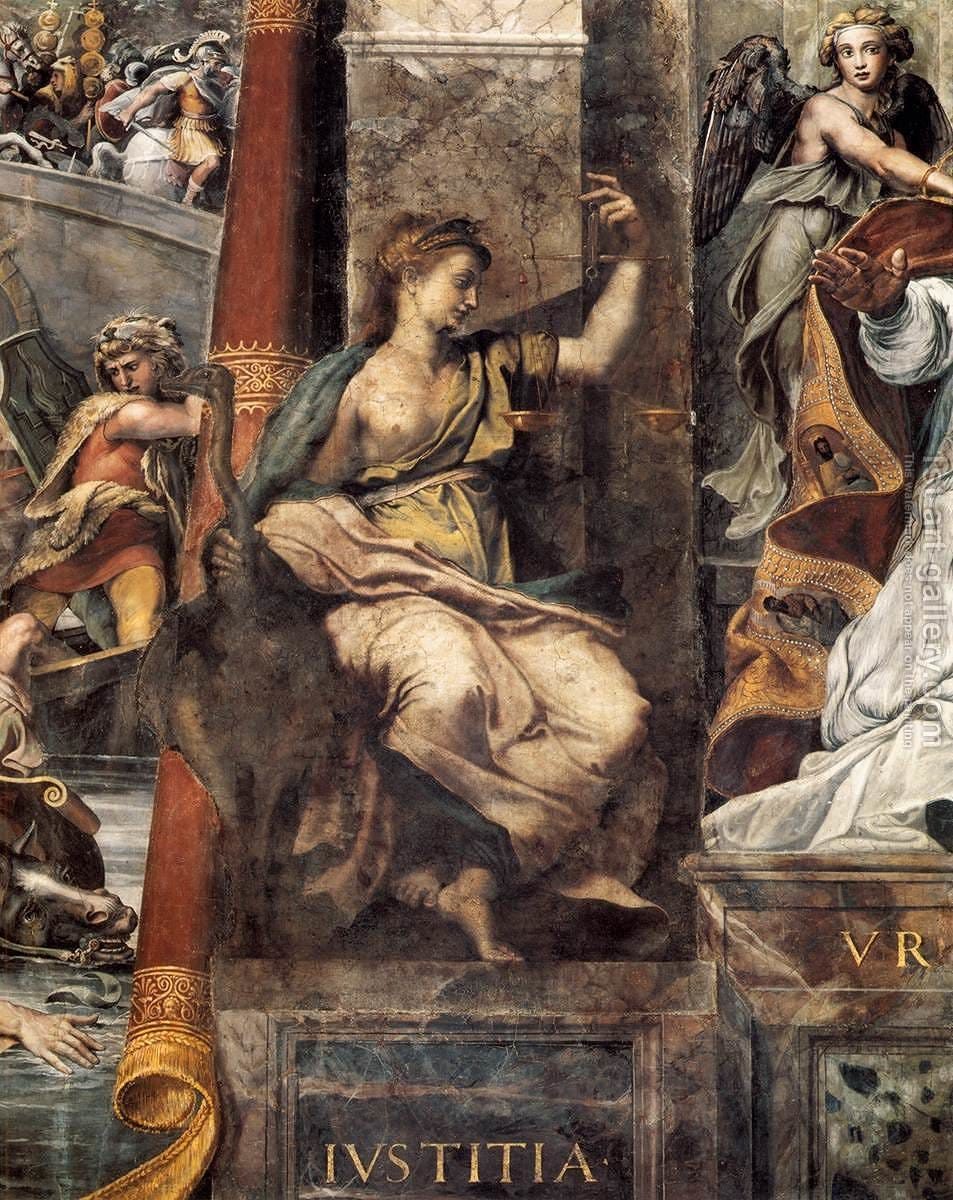
Lady Justice is blindfolded holding scales, a sword. The blindfold is meant to signify impartiality, the scales, balance, the weighing of competing claims, and the sword speaks of decision, the act of drawing a line. The early Roman depictions of Justitia showed her with open eyes. The blindfold emerged in Renaissance art as satire on biased judges suggesting Justice couldn't see the corruption before her, later on, it was reclaimed as a badge of impartiality.
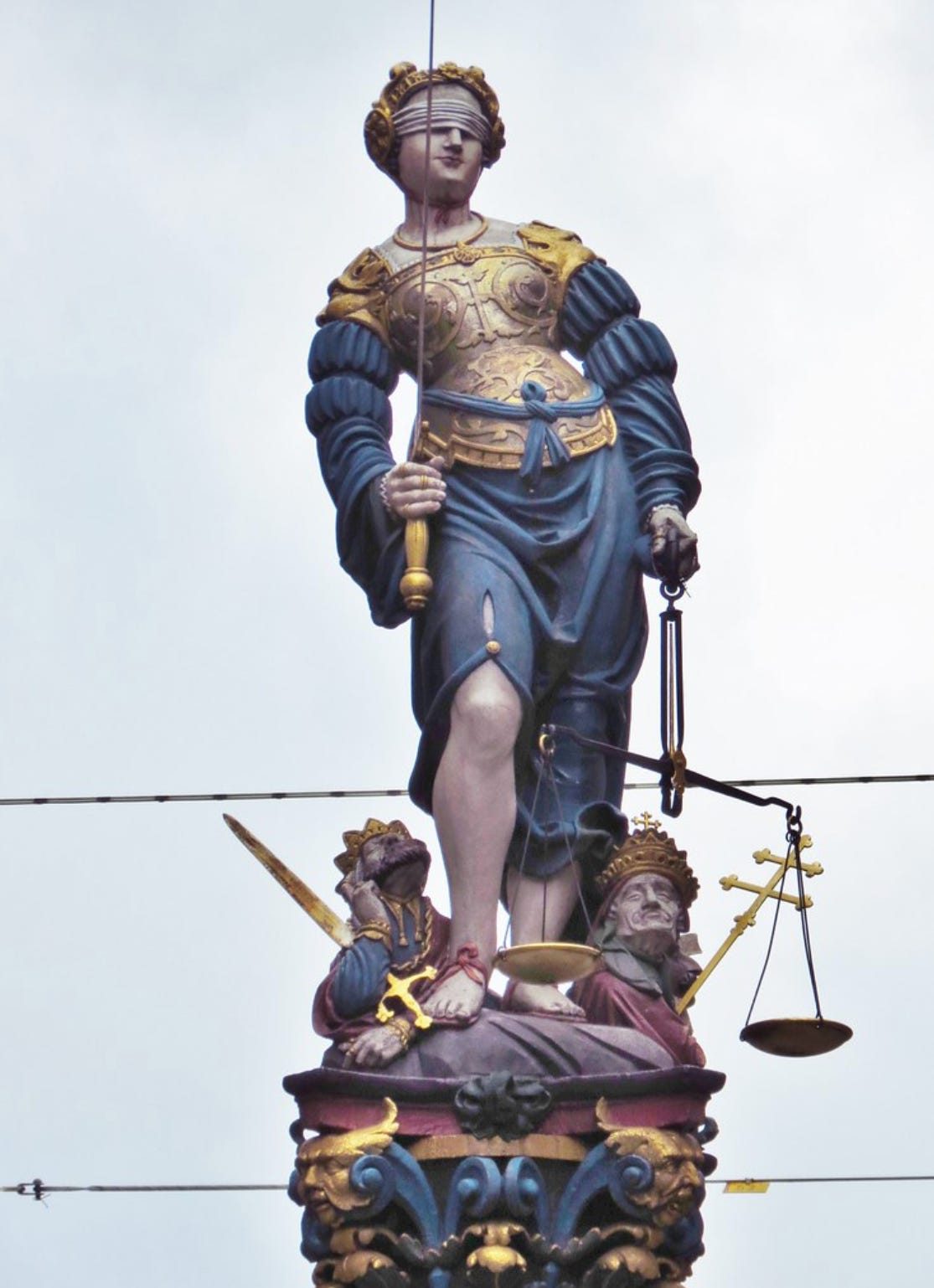
Yet today, what does it mean to celebrate a justice that “does not see” when so many are struggling with authoritarian regimes, mass incarcerations, abuse of power, migration, and the weaponization of “law and order”?
The sword has a complicated history. In Roman coins, Justitia’s sword grew large, dominating the composition, transforming from an instrument of enforcement into a symbol of state power, a reminder of who holds the monopoly on legitimate violence.

Meanwhile, the scales in Lady Justice’s hands are buckling under the weight of our expectations. Society keeps loading them with qualifiers (criminal justice, social justice, restorative justice, transitional justice, climate justice, reproductive justice, economic justice, etc.) Each adjective bends the meaning, pulling ‘justice’ toward a domain, constituency, or historical wound, distorting its true purpose. To speak of justice nowadays demands a modifier; justice for whom, in which arena, against what backdrop of injury or exclusion. The unity presumed in Ulpian’s definition splinters into a field of competing and sometimes incompatible claims. No wonder our public discourse so often feels like a permanent trial with no verdict. We inhabit a culture of simultaneous overexposure and under‑resolution: endless accusations, testimonies, and demands for redress, but very few shared conclusions about what, in the end, would count as just.
Justice, by its nature, cannot simply be seized and carried out by private hands; the moment we claim the right to “do justice” ourselves, we drift toward vengeance and away from any shared standard of the good. However normal it has become to celebrate people “taking justice into their own hands,” it is a symptom of something much more concerning, that our democracies are failing, that trust in our common institutions is eroding, and with it, the conditions that make justice possible at all.
In this climate, the language of justice is often conscripted into a culture of performative victimhood, where the claim to have been wronged is treated as a card that legitimizes any demand, even when those demands violate proportion, reciprocity, or the rights of others, and so, in the name of justice, end up asking for things that are not just at all.
But beyond its political notion, justice is a way of arranging one’s inner self. Aristotle called justice a moral quality that inclines us to do what is right. Ulpian’s take justice as a virtue also sits in this lineage. To ask “what is justice?” is, in this sense, to ask: What kind of person must I become so that rendering others their due is no longer heroic or exceptional, but habitual? What disciplines of attention, of listening, of self-limitation are required to keep that will from eroding?
Ulpian defined justice as a disposition - constant and perpetual - which is a far more demanding standard than any law could enforce. Institutions can protect that will, or they can pervert it, as we have experienced both cases. But institutions are ultimately made of people who either cultivate or abandon the interior habit of rendering others their due. When public trust erodes, when justice is taken into private hands, when every claim to victimhood becomes a blank check, what is really disintegrating is voluntas (the will). To keep that will from corrupting requires self-limitation. The willingness to ask not only what do I deserve, but what do I owe, and to sit with the discomfort of that answer. It’s the unglamorous commitment to a standard that does not bend to one’s whim. The public discourse will keep staging its endless trial with no verdict. But underneath all of it, the older question remains whether I have the will, today, to render to each their due, even when no one is watching.
In loving memory of my father, who would have turned 64 today. A steadfast defender of justice, and still my compass.
Until next week.