What Rom‑Coms Get Wrong About Immigration & Marriage‑Based Green Cards
2026-02-10 · 5 min read
My dearest incurable humanist, It’s that time of the year again. The annual mania of hearts, chocolate-induced drama, red-and-pink everything, tacky roses, and restaurant reservations that cost more than your rent. But instead of writing about the intoxicating magic of new love or the soul-crushing…
My dearest incurable humanist,
It’s that time of the year again. The annual mania of hearts, chocolate-induced drama, red-and-pink everything, tacky roses, and restaurant reservations that cost more than your rent. But instead of writing about the intoxicating magic of new love or the soul-crushing devastation of heartbreak, I’m here to talk about rom-coms. Because nothing screams Valentine’s Day quite like Hollywood’s highly unrealistic fantasies about romance, right? Only that today we’re approaching them through the lens of migration, and what they get wrong about the marriage-based immigration process in the United States, courtesy of someone (me) who has spent the past five years working in the significantly less charming reality of immigration law.

So here we go:
Green Card (1990)

The Golden Globe–winning rom‑com Green Card pairs Gérard Depardieu and Andie MacDowell in a sham marriage plot. Georges (played by Depardieu) tells stories about his frequent trips to Africa, conveniently overlooking that the INS would have reviewed his Form I‑94 which would have immediately blown his cover.
The film gets one thing right: the marriage must be real. In this case, it clearly isn’t, and the characters know it, which is why they’re so desperate to prove otherwise. That, of course, is fraud, and a federal crime (do not try this at home). The movie shows them staging photographs to convince immigration officers that they’ve traveled together and are genuinely in love.
Yet, it’s not enough to get married in City Hall, present a marriage certificate, and a handful of romantic photos. Couples must submit a thick file of evidence demonstrating a bona fide relationship. This includes joint bank accounts, shared insurance policies, co-signed leases, joint tax returns, and more.
In the movie there’s a preliminary interview in her apartment (this doesn’t happen.) When suspicion arises, they’re sent to an INS office interview, where the scheme collapses over a forgotten detail about face cream. Georges is then taken straight to the airport, with no due process.
Green Card remains a charming romantic fantasy, but as an immigration guide, it’s a one‑way ticket to federal prison with deportation as the dessert.
The Proposal (2009)

Sandra Bullock plays a high-powered Canadian publishing executive in New York who learns she’s being deported because her “visa expired.” Her solution? Marry her American assistant (Ryan Reynolds) for a green card. Cute but pointless.
Bullock’s character seems to be on a nonimmigrant work visa, maybe H-1B or TN, but we’re never told. When her boss informs her that she’ll be deported, the first red flag appears: denials don’t automatically trigger deportation. You can appeal or refile, not pack up overnight. She’s also told she’d be banned for only one year, which is wrong since deportations carry at least a five-year bar.
Then there’s the fiancé-visa plot twist. They waltzed into a local USCIS office to meet an officer without an appointment, plus the K-1 fiancé visa petition can’t even be filed from inside the U.S. The fiancé interview happens abroad at a consulate, not at your neighborhood immigration office. As if this wasn’t inaccurate enough, that same officer flies to Alaska for a surprise visit to investigate their relationship. This is pure fantasy. USCIS field officers do not travel to investigate unfiled cases, negotiate with parents, or decide fraud by hunch. Investigation and prosecution of marriage fraud involves separate units, a thorough legal process, and court, not a detective wannabe officer on a weekend trip.
Freakier Friday (2025)

In Disney’s Freaky Friday sequel, Lindsay Lohan (Anna) attends a USCIS marriage interview, except she’s actually her daughter trapped in her body. But the real freaky part is how the film twists the immigration process.
The movie shows the interview happening before the wedding. This is not accurate as green card interviews are the final step in a months-long process that requires you to be, you know, married first.
The film also ignores that Lohan’s fiancé is already living in the U.S. and running a restaurant, so presumably he’s on an O-1 or E-2 visa. Hence, he wouldn’t even qualify for a K-1 fiancé visa, which is reserved for people living outside the country.
But this really intrigued me so I did a deep dive research, and scrolling through IMDB, I found a picture that makes this even more absurd! The appointment notice visible in the scene is for Form I-90, which is used to replace a green card. This means he's already a permanent resident! Why on earth would they be conducting a marriage interview for someone who already has their green card?
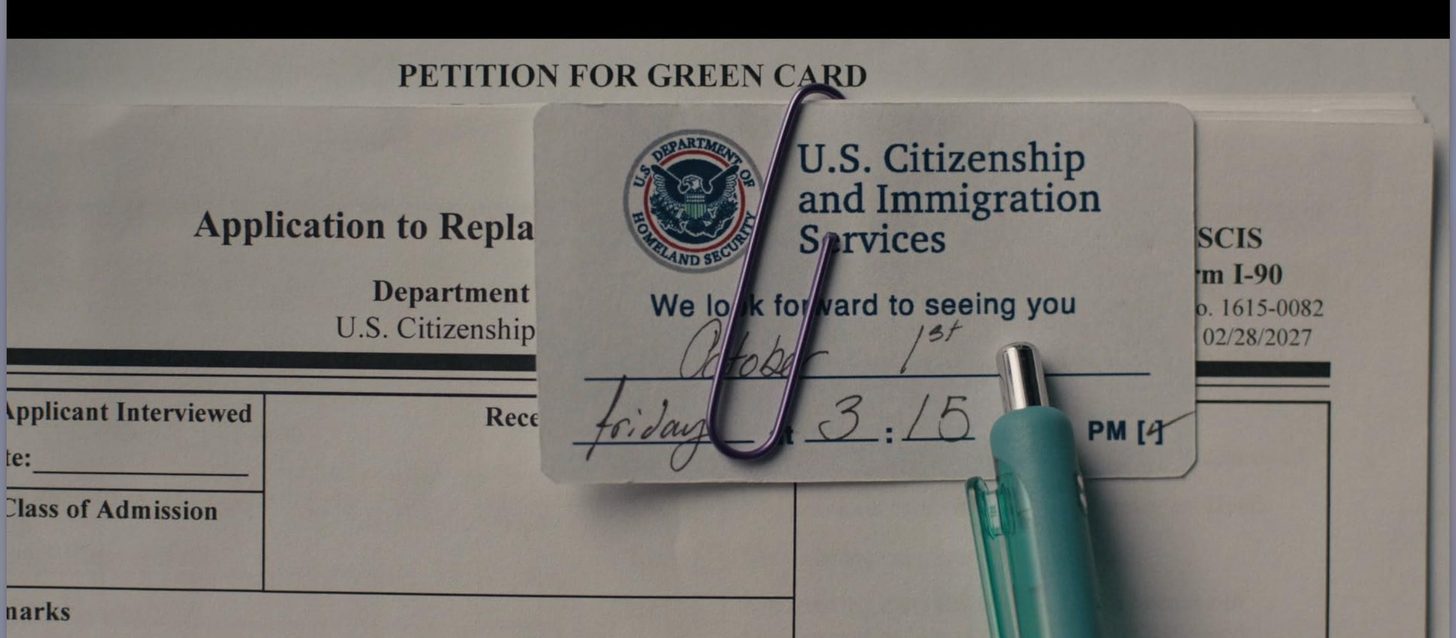
Hollywood may recycle the same clichés about love, but when it comes to immigration, they’ve got a flair for fiction. All jokes (and rom‑coms) aside, marriage‑based immigration is no punchline. It’s a serious legal process that can change lives and derail them if mishandled. With USCIS backlogs growing, shifting policies, tightened marriage‑based scrutiny, and ICE enforcement at interviews, “winging it” is a terrible idea. A reality check for hopeless romantics, the marriage‑based immigration system isn’t a rom‑com so consult an immigration attorney not a movie.
This does not constitute legal advice.
Wishing you a happy Valentine’s Day filled with love (the real kind).
Until next week!
(Read by the author. Theme song, The Incurable Humanist, by Carlos Escalona Cruz. All Rights Reserved 2025.)