You Call It Innocent. They Call It Illegal.
2025-06-03 · 7 min read
My dearest incurable humanist, People often don’t realize the importance of legal advice. Not just any legal advice, but the right legal advice. When you find yourself in a messy situation, already knee-deep in chaos with no exit in sight, it often turns out the disaster could’ve been avoided…
My dearest incurable humanist,
People often don’t realize the importance of legal advice. Not just any legal advice, but the right legal advice. When you find yourself in a messy situation, already knee-deep in chaos with no exit in sight, it often turns out the disaster could’ve been avoided entirely if you’d just spoken to a lawyer beforehand. But most people don’t. Why? Because legal advice feels expensive, intimidating, or unnecessary. Because you think, ‘That won’t happen to me’, or ‘Ugh, lawyers are a pain’ (and to be fair, we can be). So sure, skip the lawyer. Just don’t act surprised when it blows up in your face.
This happens to everyone, but especially to artists and creatives. And before you roll your eyes, I love artists. I married a music producer. I hold an MA in Modern and Contemporary Art. My life and work revolve around the cultural sphere. But artists, as a rule, don’t love structure. They don’t always love planning. And they don’t love paperwork. (Yes, yes. There are exceptions. If you’re one of them: congrats! We love a Type A rockstar. Now let me get back to the point.)
Let’s talk about immigration and artists because that’s my domain, and because, well, it’s at the center of national debate and on every front page. The U.S. immigration system has clear visa categories for individuals with extraordinary abilities: the O-1B and the P-1B. Now, the basics. While they serve similar purposes, the key difference lies in who the spotlight is on, the individual or the group.
The P-1B visa is designed for members of internationally recognized entertainment groups. Solo performances are not permitted under this category. The group itself must have a strong international reputation, and at least 75% of its members must have performed together for a minimum of one year. Interestingly, “international recognition” doesn’t require a global tour; acclaim in both the group’s home country and the United States is typically sufficient.
On the other hand, the O-1B visa is tailored for individuals who possess extraordinary ability in the arts. But what does “extraordinary” mean? According to U.S. immigration standards, it’s not about superstardom, it’s about distinction: a level of achievement that’s significantly above the norm. To qualify, the individual must either have received a major, internationally recognized award (such as an Oscar or a Grammy) or meet at least three of six criteria.
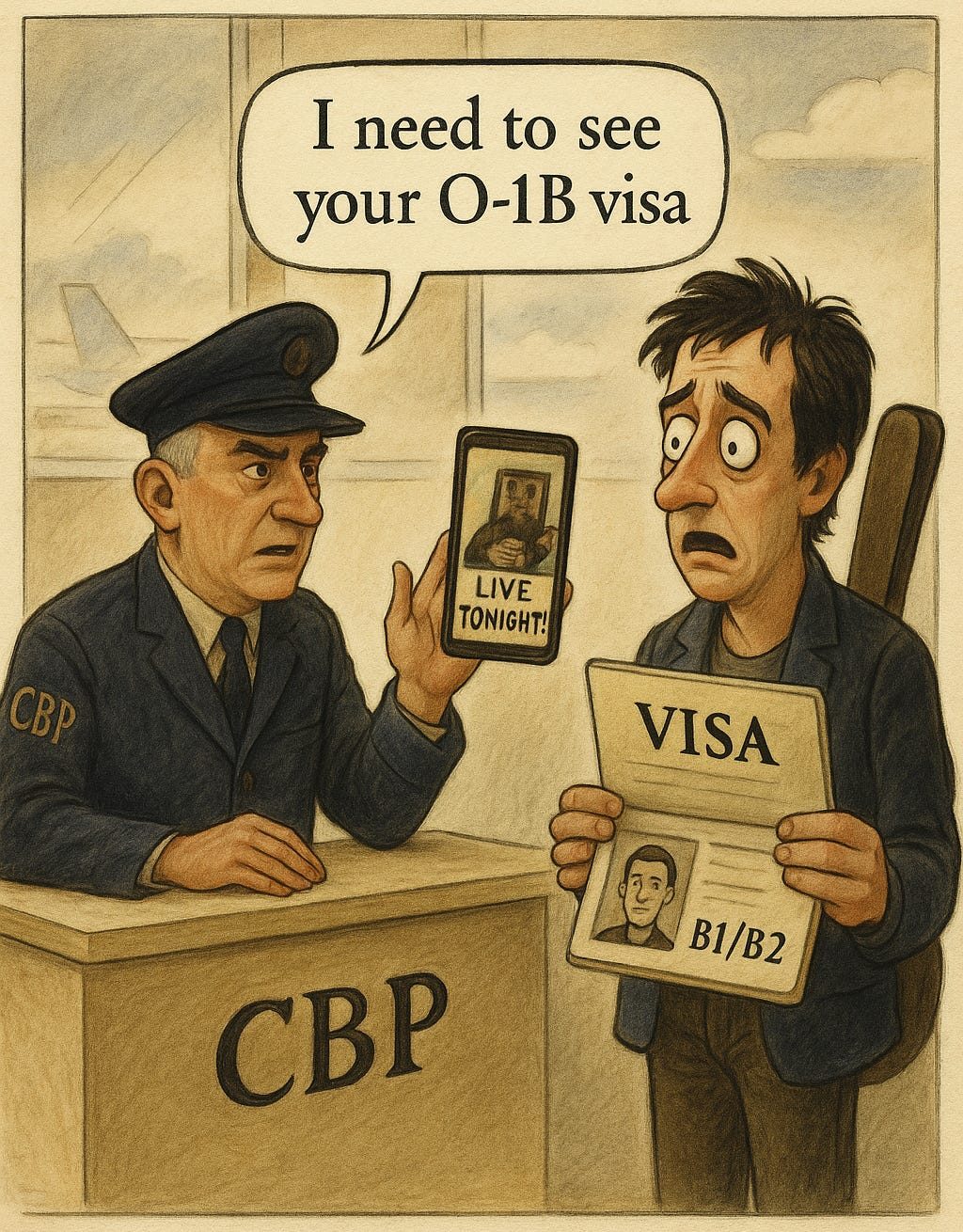
Still, many people enter the U.S. on a B1/B2 visa or through the Visa Waiver Program (ESTA). If you’re here as a tourist, there are things you can do as an artist: attend or speak at conferences, record music in a studio, promote your work in interviews, and participate in a residency. What you cannot do: perform, get paid, or participate in a commercial show. That’s unauthorized work. That’s a no-no. That’s how you end up banned or deported.
I could give you a thousand cautionary tales of artists who thought they were ‘just doing a small show,’ ‘got paid under the table’, or ‘told the officer they were coming to visit when really they had scheduled a show’ … all banned. Some for three years. Some for ten. Some indefinitely. But instead, I’ll tell you my own story.
As a teenager, I was an aspiring singer-songwriter. I started writing songs at 14, influenced by Avril Lavigne. I admired how she dropped out of high school in Canada and moved to New York after being signed by L.A. Reid. If Avril could do it, why not me? I spent hours emailing A&Rs, producers, and music executives; you get the picture.
During a trip to New York, a producer responded. I was 17, filled with hope and ambition. We chatted, I sent demos, and even though my vacation was nearly over, we agreed to meet the next time I was in town. When I returned in September, we finally met. My mom came with me (naturally skeptical), but to her surprise, it was legitimate. We recorded a track called Terms & Conditions (I know, very on-brand, right?). As noted above, recording while on a B1/B2 visa is allowed.
Three weeks later, I was back in Caracas, finishing my last year of high school, but my head was still in New York. I released the song on January 8th, 2013. Somehow, it made its way onto the radio in Australia and into the pages of a Brazilian magazine. For a moment, it felt like I was doing it. No budget, no marketing plan, just wishful thinking. (Strategy? Industry know-how? Things I would later come learn, courtesy of my husband, but that’s another story.)
I kept in touch with my producer, and once I graduated high school, the plan was to return to New York that summer to record an album. But that never happened. The paperwork started, and according to a lawyer I consulted, it would’ve had me signing away my soul. So, I walked away defeated.
Still, I kept pushing and I found a vocal coach who had trained Broadway and pop singers and started taking private lessons. I recorded a new demo. Suddenly, I was back to thinking maybe this could still happen. I wanted to stay in New York for a year to focus on my music. I didn’t think about the fact that I was on a tourist visa. I begged my parents to let me stay. They said no. At the time, I thought they were ruining my life. My dad wanted me to go back to Venezuela and start law school, which felt like the end of everything I cared about.
A U.S. attorney got involved and told my mom they weren’t parenting me ‘correctly’ and that I should stay, because I needed to be in New York if I wanted a shot. Which, okay, true. But he also told us I could wait tables to support myself. Which … is illegal on a tourist visa. And this was coming from legal counsel. You, see? It’s not just about getting legal advice; it’s about getting it from someone who knows the specific area of law. If I had stayed, I would have violated my status. That could’ve meant being barred from returning to the U.S. for years or maybe forever. It wouldn’t have been out of bad faith just plain ignorance. But the law doesn’t care about your intentions. It only cares about actions. Thank God my dad was so strict and made me go back.
Years later, life rerouted me to New York anyway, this time to do a master’s in modern and Contemporary Art and the Market at Christie’s Education. As part of my graduation requirements, I had to complete an internship and that’s how I found my way back to law. But not just law: immigration law, of all things. I started working on visas for artists and realized just how high the stakes are. It was a full-circle moment. I understood how close I had come to lose it all, just because I didn’t know the rules.
I want to help people avoid that. I want artists to have the right information, so they don’t unknowingly risk their futures. Yes, there are extreme circumstances, refugees, asylum seekers, people who truly have no other options. But, right now, I’m talking about artists who want to come here to work. If that’s you: do not perform and get paid without proper authorization. Do not post about it on social media but even if you don’t, they will find out. Call a lawyer. Get your visa. Don’t rely on Instagram, TikTok, or a Substack like mine (this does not constitute legal advice). Get a real consultation tailored to your situation.
And especially now, with immigration at the center of national debate and enforcement getting stricter by the day, don’t risk it. Don’t assume you’ll be the exception. You won’t. You are not above the law. And let me be blunt: if you’re not a U.S. citizen or permanent resident, you cannot work or perform in the United States without authorization.