Francisco de Miranda: The Original Incurable Humanist
2026-03-31 · 7 min read
My dearest incurable humanist, Even if you are not Venezuelan or Latin American, you have probably heard of Simón Bolívar, the “ Liberator ” who led the independence of Venezuela, Colombia, Ecuador, Peru, Bolivia, and Panama. But I’m not here to talk about Bolívar. Today I want to introduce you to…
My dearest incurable humanist,
Even if you are not Venezuelan or Latin American, you have probably heard of Simón Bolívar, the “Liberator” who led the independence of Venezuela, Colombia, Ecuador, Peru, Bolivia, and Panama. But I’m not here to talk about Bolívar. Today I want to introduce you to my favorite Venezuelan historical figure: Francisco de Miranda. You know how people always ask, “If you could have dinner with any famous person from history, who would it be?” Mine is Francisco de Miranda, without a doubt. Miranda was the ultimate networker, the mastermind behind the independence ideology that Bolívar would later claim as his own, and unequivocally an incurable humanist too.
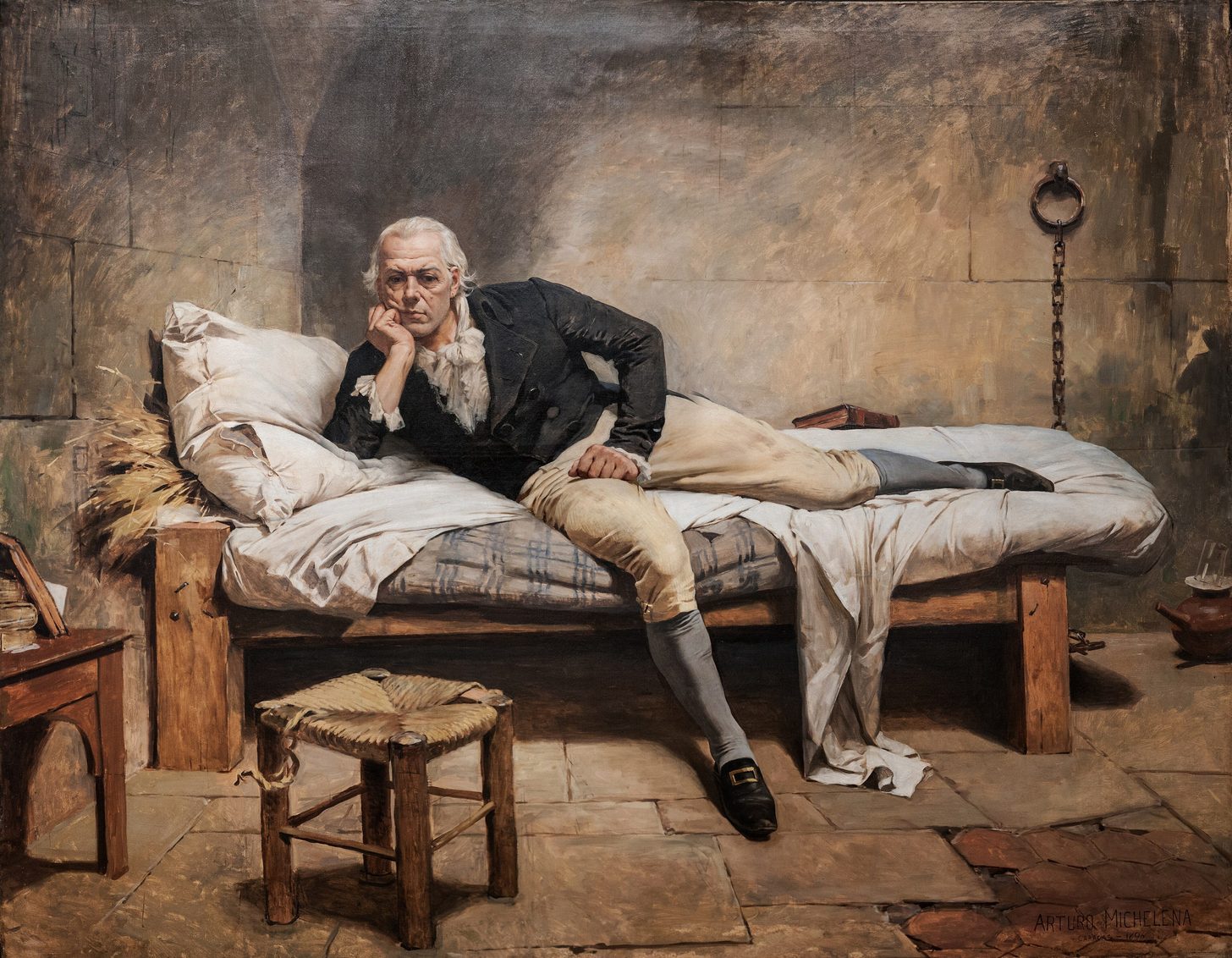
Francisco de Miranda was born in Caracas on March 28, 1750, into a wealthy merchant family of Canary‑Island descent. He was educated under the humanist curriculum of the Real y Pontificia Universidad de Caracas, where he mastered Latin, Greek, and the classical arts. In 1771 he left Venezuela for Spain and fought in campaigns in North Africa, the Caribbean, and in the American Revolutionary War. By the early 1780s he was already suspected of disloyalty to the Spanish Crown; after being accused of financial misconduct in Cuba, he fled. Miranda traveled across Europe, constantly networking with officers, diplomats, and intellectuals. He spent long periods in London, becoming a key figure among exiled patriots and lobbying British authorities for an armed expedition to liberate Spanish America. He also immersed himself in the French Revolution, serving as a general in the early 1790s, fighting at Valmy and in the Flanders campaign. When the Revolution turned more radical, he was accused of treason, imprisoned, and later released. Fun fact: his name is engraved on the Arc de Triomphe in Paris.
During this odyssey, he also spent time in Russia, where he was received at the court of Catherine the Great. Rumors circulated that the two were lovers, a story that fits Miranda’s image as a kind of Casanova.
All his travels were documented in his diaries. As such, some historians have called him the first Venezuelan art critic. He began his travel diary in 1771 without intention of publication, he set out to read the “great book of the universe,” traveling through North America, and describing cities like Philadelphia before most other visitors had done so. His entries record not only political and historical observations, but also detailed comments on music, painting, and architecture, making him one of the most prolific memorialists of the age.
For decades scholars thought his archive was lost, until in 1926, through the efforts of Dr. Caracciolo Parra Pérez, Venezuelan Chargé d’Affaires in London, the British government transferred to Venezuela sixty three volumes of Miranda’s manuscripts which had been preserved in the Public Record Office as Spanish state papers. His letters with figures such as Antoine Quatremère de Quincy, for example, show how he understood the arts as tools of civic education and moral refinement. Long before he encountered the work of the great art historian Giorgio Vasari (whose Vite de’ pittori, scultori ed architetti he bought on his last trip out of Italy) Miranda had already developed his own critical eye for form, proportion, and meaning in the visual world. Miranda’s formation was deeply classical. He read the architectural treatises of the Roman Vitruvius and the philosophical reflections of Cicero on the fraternity of the arts. His personal library was one of the richest of any Latin American of his century, comprising over six thousand volumes spanning philosophy, political economy, and the fine arts.
Music was another of Miranda’s lifelong passions, though he was strictly an amateur. He played the transverse flute and the pianoforte, and traveled to Greece, the birthplace of Homeric epic, to study the deep roots of classical culture. In his observations from Cuba, he notes popular dances that other chroniclers glossed over, describing how the population began to dance sensually, an early instance of his attention to the social meaning of performance. In Vienna he met the greatest musicians of his time, including Haydn, whom he admired above all others.
In the realm of visual arts, Miranda was even more surprising. He was the first to remark that Michelangelo’s Moses in the Church of San Pietro in Vincoli could not be properly appreciated in its cramped niche, a purely formal‑aesthetic critique that anticipates later art‑historical writing. In Rome and Florence he engaged with the emerging discourse of art criticism, which was just beginning to crystallize in the Enlightenment.
In 1806 Miranda launched an expedition from New York, sailing on February 2 aboard the Leander. On August 3, he raised the tricolor Venezuelan flag for the first time at La Vela de Coro, but local support was weak and the attempt collapsed. He returned to London, refined his vision of a vast independent American empire stretching from the Mississippi to Cape Horn, and remained in touch with younger revolutionaries such as Simón Bolívar. In 1810, after the first Venezuelan uprising against the Regency in Spain, Bolívar and Miranda joined forces in London and sailed back to Caracas, where Miranda soon assumed the highest military and political authority in what would become the First Republic of Venezuela.
The First Republic (1810–1812) collapsed under a mix of internal divisions, economic crisis, the absence of a centralized army, and the devastating 1812 earthquake, which some framed as divine punishment. The royalist offensive led by Domingo de Monteverde, combined with Miranda’s capitulation at San Mateo in July 1812, brought the republic to an end. In the chaos that followed, Bolívar took part in the arrest and surrender of Miranda at La Guaira on 31 July 1812, branding Miranda’s negotiation with the Spanish as cowardice and betrayal. Miranda was handed over to the Spanish authorities, exiled to the Arsenal de La Carraca in Spain, and died in prison in 1816.
Miranda’s downfall demonstrates how in politics, the clearest ideals often dissolve in the murk of ambition. Even those who fight for the same cause may turn against each other, seeking protagonism. The obscurity of politics lies in the space between conviction and performance, between loyalty and the will to shine alone.
Bolívar would later regret Miranda’s imprisonment and death, and called him “the most illustrious Colombian,” maybe as an effort to rewrite guilt. He recognized, too late, that Miranda had been many men in one: a soldier, a diplomat, a dreamer, and a humanist who believed that art, knowledge, and virtue were essential to the making of a republic.
Two centuries later, Venezuelans are fighting our own chains. The dictatorship that has destroyed every institution, silenced dissidents, and forced over 7 million of us into exile is not a foreign occupation but an internal one, rooted in fear and hunger.
Many outside Venezuela fail to understand the joy or relief that so many of us feel when real pressure is finally applied against that regime. Critics abroad speak of “foreign interference,” but for those of us who have spent decades pleading, protesting, and enduring, this has felt like a breath of possibility. We tried everything from within — dialogue, elections, petitions — and nothing changed.
María Corina Machado, like Miranda before her, now fights from exile. Her decisions may confuse or disturb some, especially when they clash with the sensibilities of those who have not lived this despair firsthand. But politics, as Miranda knew, demands compromise. There are moments when you must make concessions not to lose the war. As he once saw, the pursuit of liberation requires both imagination and strategy, and sometimes, the courage to act in ways others won’t yet understand. To reject Machado now would repeat the same mistake Bolívar made at La Guaira. Venezuela’s path to democracy is not yet secured, but it must be built on unity.
Miranda remains, to me, the original incurable humanist. His revolution failed, his allies abandoned him, and yet his ideas outlived them all. For every Venezuelan who still dreams of freedom, his life is a reminder that liberty begins in how we think.
Another fun fact: as I was finalizing this essay, I realized Miranda was born on March 28, 1750, so, last Saturday was his 276th birthday!
Until next week!