María Corina Machado and Venezuela’s Fight for Freedom
2025-12-16 · 16 min read
My dearest incurable humanist, As you might have noticed Venezuela is now on every front page and breaking news as María Corina Machado (MCM) was awarded the Nobel Peace Prize last Wednesday December 10, 2025 for her tireless work promoting democratic rights and for her struggle to achieve a just…
My dearest incurable humanist,
As you might have noticed Venezuela is now on every front page and breaking news as María Corina Machado (MCM) was awarded the Nobel Peace Prize last Wednesday December 10, 2025 for her tireless work promoting democratic rights and for her struggle to achieve a just and peaceful transition from dictatorship to democracy in Venezuela.
I don’t intend for this newsletter to become political propaganda. But as a Venezuelan, I’ve been asked repeatedly in recent weeks what is happening in my country, and I feel a responsibility to respond from my perspective, a 30-year-old lawyer based in New York. What follows is my attempt to offer context. Much has unfolded over the past two decades, far more than can be summarized here. Still, I’ve tried to make sense of it in a way that’s accessible even if you’re unfamiliar with Venezuela’s history. Recent portrayals of María Corina Machado as “far-right,” “extremist,” or “not peaceful” flatten a far more complex reality. Venezuela’s crisis no longer fits within traditional left–right political frameworks. Before ideological debates are even possible, the country must first recover its most basic democratic freedoms.
I was born and raised in Caracas, Venezuela, in 1995. In December 1998, Hugo Rafael Chávez Frías won the presidential election. Ever since, my life, as well as the lives of 30-something million Venezuelans, was forever changed by what he coined the Twenty-First Century Revolution, which in reality roughly translates to tyranny, collectivism, government control, and immeasurable pain.
Maria Corina Machado and I attended the same school, Academia Merici, an Ursuline school in Caracas, where the motto is “Serviam”: service to others. I believe she is the best example of serviam that I have ever witnessed, as she has dedicated her life to serving Venezuela. In 2011, she had just been elected as a member of the National Assembly. She came to our school for a Mass, and at the time of the peace, I approached her. I was 15 years old, and I told her that I deeply admired her because she was a concrete example of setting a goal and achieving it. I hugged her and went back to my seat. After the Mass ended, she gave a speech. She told us that her father’s greatest inheritance to her was her education. Those words hit me. My father told me this same thing every single day. After her speech, she called me out, and I had the chance to have a brief conversation with her. My admiration for her has only grown through the years for her moral stand and unbreakable values. Even then, at 15, I could sense something in her coherence, refusal to compromise on principles, and commitment to freedom.
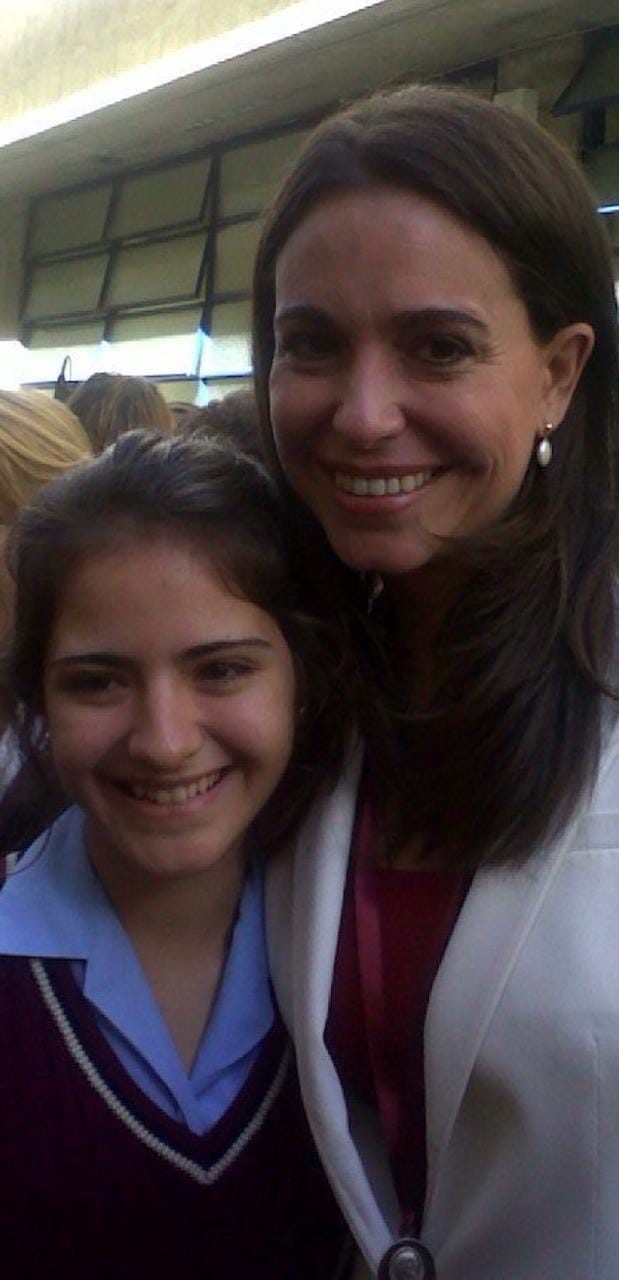
The thing to understand about living inside a regime is that there are layers, many stances, and many reasons why a society reaches that point. Even among the opposition, there are differing points of view that clash with one another. And I have come to know that this is a pattern that repeats itself in every authoritarian society around the world.
I had the immense privilege to leave and build a life in New York, which was always my dream. Yet, migration is a hard process. As gratifying as it might be to escape a terrorist government, there are frequent times of uncertainty, of loneliness, of despair, of wondering whether this distance is worth it, only to realize that going back was not an option. In that sense, I am cognizant that my experience is unique to me, but also that I am just a number. I am one of 9 million Venezuelans who have migrated. Victimization does not suit me well, and even with whatever I might have endured, I am well aware that someone has had it worse or has a much more interesting tale to tell. To each person, their story is their identity, their scars, their dreams. This has been a lingering thought in my mind for a few years now, since I have worked in US business immigration law and in the art world. I have met people from hundreds of nationalities and backgrounds with diverse goals and worldviews, each one a story behind the statistics. This is mine.
Venezuela has the largest oil reserves in the world, and everything needed to succeed. Yet prosperity seems like an obscure goal that was almost achieved during the 1970s. Nowadays, it has become nothing but a vague memory that lies back in the minds of those who lived it, or in the romantic aspirations of people like me, who fantasize about being able to feel safe, free, stable, and develop a life in our own country.
It was Sunday, December 6th, 1998. It was a rainy day, and I accompanied my parents to vote. That night, the results were announced. Hugo Rafael Chávez Frías was elected president of the Republic of Venezuela. My home was filled with disappointment. Hugo Chávez led an armed military rebellion against Venezuela’s democratically elected government in February 1992, which constituted a serious criminal insurrection under Venezuelan law and resulted in deaths, injuries, and significant damage. He was imprisoned for this failed coup, but in 1994 President Rafael Caldera pardoned him. At three, I was not able to comprehend or imagine the magnitude or importance of what I would live with for the rest of my life.
From then on, politics became a subject that was present even if one wished to avoid it. It was gradual, but Venezuela was divided into two and was filled with rage and resentment. This routine, the day-to-day, is the most dangerous because, since humans are creatures of adjustment, Venezuelans started to unconsciously adapt to the debacle.
According to leading economic freedom indices, Venezuela went from being among the world’s most free countries around 1980 to ranking near the very bottom of global economic freedom rankings in recent years. Many intellectuals and highly educated businessmen supported Chávez in the beginning; the rising inequality and social problems were complex, and people were seeking change. Nevertheless, it did not take long for Chávez to reveal his true colors.
In 1999, Chávez convened a Constituent Assembly to replace Venezuela’s 1961 Constitution using a mechanism that was not in the existing Constitution. The 1961 Constitution had a specific amendment process through Congress, but Chávez bypassed this by invoking a lower-ranking law, the Ley Orgánica del Sufragio y Participación Política (Organic Law on Suffrage and Political Participation). Despite the fact that an ordinary law could not override constitutional amendment procedures, a compliant Supreme Court validated this approach, allowing Chávez to hold a referendum that approved the Assembly’s creation. His allies then dominated the elections, giving them control to draft a new Constitution. The Assembly proceeded to dissolve Congress, intervene in the judiciary, and dismantle checks and balances before approving the new Constitution in December 1999.
Tragically, the final referendum coincided with the Vargas disaster, catastrophic mudslides that killed thousands, revealing the regime’s incompetence. Chávez’s administration failed through poor preparedness, chaotic relief coordination, and slow reconstruction, a disconnect between revolutionary rhetoric and governance capacity that would only deepen over the years.
The new Constitution introduced the ley habilitante (enabling law), allowing the National Assembly to temporarily delegate legislative powers to the president for up to 18 months on specific matters. Chávez used this mechanism repeatedly: first in 1999 for financial and tax reforms, then in 2000–2001 for matters covering economy, crime, and ministry reorganization (producing the controversial 49 laws on land, fishing, and banking), and again in 2007–2008 and 2010–2012 for up to 18 months each time, covering economic, social, territorial, defense, and scientific matters.
The problem is that these categories were so broad that Chávez could legislate on virtually anything without normal parliamentary debate. This concentrated power in the executive, weakened legislative oversight, and undermined the system of checks and balances essential to democratic governance. This created a dangerous precedent for authoritarian rule.
In April 2002, his firing of PDVSA oil executives triggered massive protests that culminated in violent clashes killing 19 people and a brief coup that lasted 47 hours before he returned to power. Chávez’s subsequent purge of thousands of oil workers set the stage for the December 2002-March 2003 oil shutdown that crippled the economy, after which he permanently politicized PDVSA and weakened its technical capacity.
In 2004, Chávez faced a recall referendum after the opposition collected over 2.4 million signatures amid economic crisis, political unrest, and growing backlash against his radical reforms. Despite allegations of fraud and exit polls suggesting his removal, the government declared a 59% “no” vote, allowing Chávez to remain in power. He then leveraged surging oil prices to fund expansive social programs like misiones while weakening democratic institutions through unconstitutional maneuvers.
Beginning in 2006, Chávez established poder popular, a parallel system of communal councils and communes that contravened the Constitution. With full control of the National Assembly, his government carried out sweeping expropriations across industries, accelerating capital flight, corruption, and economic decline. When voters narrowly rejected a 2007 constitutional reform that included indefinite reelection, Chávez simply repackaged the proposal and passed it in 2009, eliminating all term limits. That same consolidation of power extended to the media. In 2007, the government refused to renew the license of RCTV, Venezuela’s oldest and most-watched private television network, forcing it off the air and replacing it with a state channel. The move triggered mass protests and international condemnation, marking a decisive blow to press freedom.
In 2010, MCM, won the highest individual vote count nationwide in the National Assembly elections and became a primary target of regime brutality. On May 7, 2013, pro-Chávez deputies physically assaulted her on the Assembly floor during a brawl over opposition protests, pulling her hair, throwing her to the floor, and kicking her in the face while Assembly President Diosdado Cabello laughed without intervening. She was later expelled from the Assembly in March 2014 for supporting the protests.
Throughout his presidency, Chávez rigged elections, politicized the courts, silenced opponents, and used oil wealth to sustain patronage while dismantling the institutions meant to hold him accountable. By the time of his 2012 reelection, the process had become a clear abuse of power. After Chávez’s death in 2013, Nicolás Maduro inherited and deepened the tyranny. His narrow and contested victory that year marked the beginning of a rapid collapse: repression intensified, shortages spread, violence escalated, political prisoners multiplied, and mass migration followed. Economic mismanagement and the oil price crash triggered hyperinflation, widespread scarcity, and historic GDP contraction. In 2014, protests led by Leopoldo López were met with lethal repression and his imprisonment on internationally condemned charges, exposed the regime’s increasing reliance on violence. This all happened during my freshman year of law school at Universidad Católica Andrés Bello. I watched and learned the collapse of the rule of law. The courts became instruments of repression. When protests intensified, bombs went off outside the university, students filled the streets, friends were beaten and injured, and others had to flee the country overnight to escape persecution.
In December 2015, Venezuela’s opposition won a landslide victory, securing 112 of 167 seats in the National Assembly. Maduro immediately fought back using his loyal Supreme Court to strip the Assembly of its powers and declared it “in contempt” triggering over 100 days of protests. Millions took to the streets demanding democracy, including 7.6 million who voted in a symbolic opposition referendum against Maduro. The regime crushed the demonstrations brutally, the National Guard, intelligence service, and pro-government armed gangs used, guns, tear gas, and torture. Over 125 people died, thousands were injured, and over 15,000 were arrested. Eventually, facing relentless violence with no results, the protests collapsed. Maduro created a parallel Constituent Assembly through executive decree. After a rigged election, this new body seized all legislative power.
Since 1999, Venezuelan museums have been almost entirely dependent on state funding, losing autonomy to manage finances or seek private support. With inflation surpassing ten million percent, government contributions became effectively nonexistent, leaving staff with symbolic salaries and institutions operating in unsafe, inhumane conditions. During my internship at the Contemporary Art Museum of Caracas (2017–2018), I witnessed this collapse firsthand: nonfunctional fire extinguishers, no air conditioning, minimal security, and artworks deteriorating from humidity and fungus. Despite this, longtime employees showed up every day out of pure devotion to art, earning salaries that couldn’t cover a single day’s meals. Political interference was just as devastating as financial neglect. In 2001, Chávez publicly dismissed Sofía Ímber, the museum’s founder, during a live radio broadcast, accusing her of elitism and purging her and the entire board to replace them with political loyalists. Under Maduro, this continued. In 2017, the museum was renamed after Armando Reverón, largely incoherent since most of his works belong to another institution. Working there revealed the human cost. Posters warned, “Aquí no se habla mal de Chávez.” (Here we do not speak ill of Chávez.) Employees lacked money for transportation. One colleague took his own life, unable to pay basic bills. Many relied on CLAP food boxes (a government program introduced in 2016 that became a tool of social control, tying access to political loyalty). These experiences shaped my understanding of art, law, and politics, and informed my master’s thesis at Christie’s Education: Sofía Ímber and Patricia Phelps de Cisneros: Two Female Power Players, Two Art Collections, and the Venezuelan Debacle.
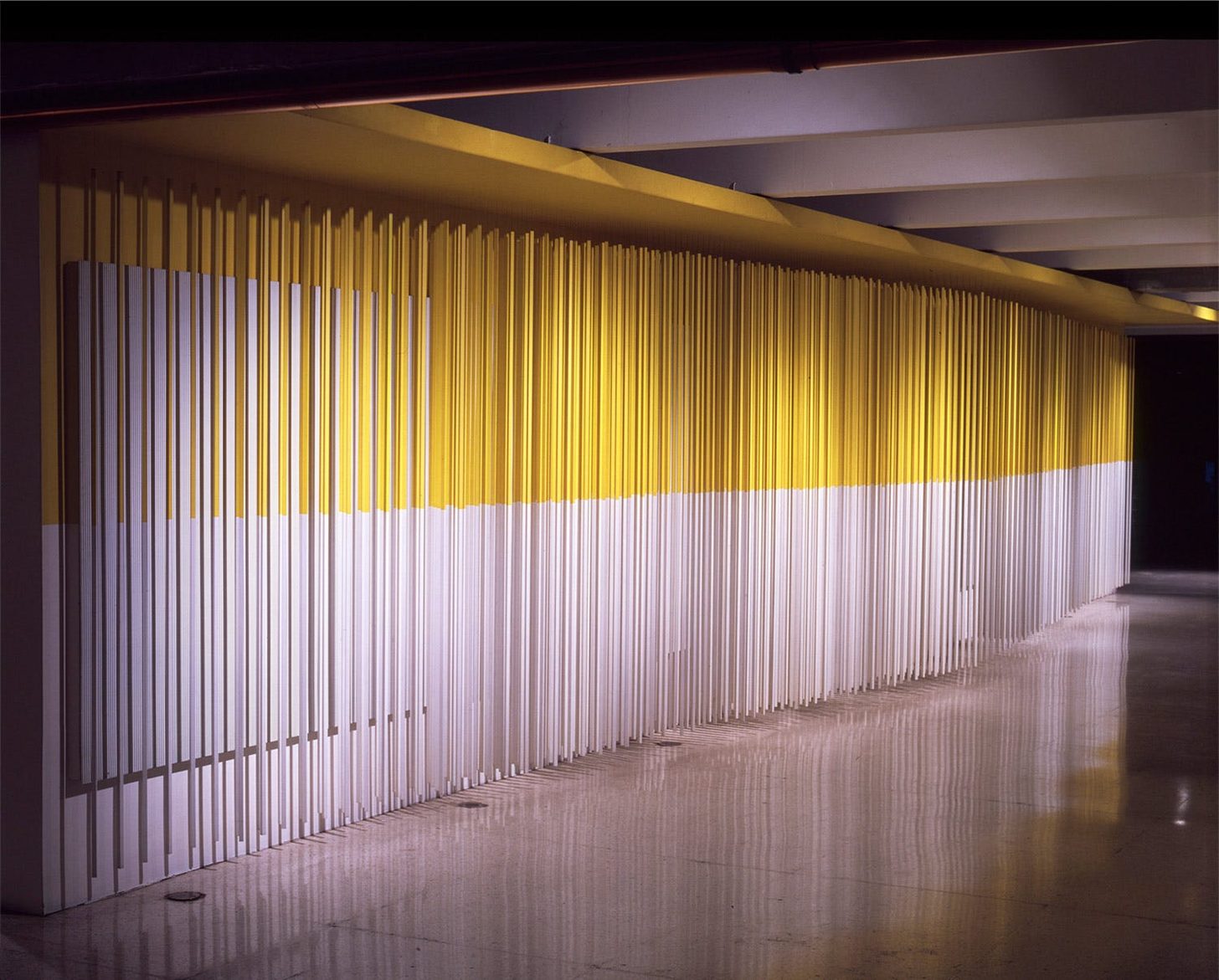
In 2018, Maduro stole the presidential election. National Assembly President Juan Guaidó invoked Article 233 of the Constitution to declare himself interim president in January 2019, gaining recognition from over 50 countries and massive popular support. But Maduro clung to power through military repression, torture, and Cuban intelligence, driving millions into exile.
On March 7, 2019, I was home studying for a law exam when we lost power. The nationwide blackout began with a fire at the Guri Dam, which supplies 80% of the country’s electricity. The already-failing grid, riddled with corruption, neglected infrastructure, and staffed by soldiers instead of engineers, collapsed completely. The blackout lasted a week, with subsequent outages through late March. There was no electricity, no internet, no mobile coverage, 96% of the country went offline. No gas, no medicine, no water. Food spoiled. People died in hospitals every hour. To get cell reception, we had to drive to the highway and park on the side. The lucky ones with water tanks bathed with buckets; not everyone had that privilege. This was one of the most terrifying things I’ve lived through. Maduro blamed U.S. “electromagnetic sabotage” and Guaidó, while experts cited decades of mismanagement under Chavismo.
I left Venezuela in 2019. Not one single year since 1999 was ever ‘normal’.
After the pandemic, the regime launched a propaganda campaign claiming Venezuela was “fixed” pointing to new restaurants, stores, and stocked supermarkets. It’s true they exist, but at what cost? Prices are extremely high, regular people cannot afford them, and inequality is worse than ever. There’s still no medicine and no functioning education system, nearly 4 million children are out of school.
Meanwhile, El Helicoide, in Caracas, is one of the world’s most atrocious torture centers to date. The regime has detained opposition activists, journalists, students, and human rights defenders in inhumane conditions without natural light, water, or sanitation.
In 2022, my father, a lawyer who defended private property rights, disappeared. Twelve days later, his body was found severed and shot. I cannot bring him back. But I can honor him by refusing to let his death become just another data point in Venezuela’s tragedy. He believed until his last breath that freedom would arrive. He never gave up hope. He even earned his PhD in Constitutional Law so that when the time came, he could be part of rebuilding Venezuela’s institutions. But he never got that chance.
A December 2025 UN Fact-Finding Mission confirmed that the Bolivarian National Guard has committed crimes against humanity for over a decade, including arbitrary killings, mass detentions, torture, sexual violence, and systematic persecution of political opponents during protests.
Despite everything, María Corina Machado achieved what seemed impossible: she united the country and restored hope. She faced the regime fearlessly, maintaining her liberal stance against authoritarian power. She was politically barred from office, despite winning the opposition primary with 93.13% of the vote, her leadership remained unstoppable. As a strategist, she registered her ally, Edmundo González Urrutia, as the presidential candidate.
On July 28, 2024, Venezuelans went to the polls knowing what was at stake: freedom or captivity. Millions abroad, including me in the U.S., couldn’t vote due to severed diplomatic ties. Despite incidents throughout the day, nothing stopped the desire for change. This time, citizens stayed at voting centers to monitor the count and secure the records.
At midnight, the regime announced Maduro had won with 51.2% of the vote, mathematically impossible, as experts immediately noted. The next day, MCM proved the fraud. With 73.2% of the voting records, she showed an “unequivocal and mathematically irreversible” victory: González Urrutia received 6,275,000 votes to Maduro’s 2,759,000. The results were published online for the world to see.
What followed was brutal. Deaths, over a thousand detentions, and arrest orders for MCM and González Urrutia. Machado went into hiding in August 2024, coordinating the opposition from clandestine locations inside Venezuela. In January 2025, she briefly emerged for a protest as Maduro was being sworn in, and returned to hiding. She managed to escape Venezuela to accept the Nobel Prize in Oslo, but she didn’t arrive on time. Her daughter, Ana Corina Sosa, delivered her speech; a powerful reflection of her mother’s spirit.
Throughout 2025, detentions continued and persecution intensified. González Urrutia’s son-in-law was sentenced to 30 years in prison.
What will happen now? I don’t know. Nobody truly knows. I don’t think we can handle yet another disappointment. There are days when I lose hope and think it’s impossible. Other days, like today, I choose to remain hopeful that freedom is near.
But now comes the harder part: What will we do with our freedom? Freedom, I have learned, is a responsibility. We carry different scars, different stories, different levels of loss. Some collaborated with the regime to survive. Some stayed silent. Some fled. Some lost everything while others salvaged something. And this is where the real work begins.
It would be easy to spend the next years settling scores, pointing fingers, demanding accountability. I understand that impulse. But we have 26 years of evidence that a society built on resentment, division, and dehumanization becomes a prison, regardless of who holds the keys. So we have a choice: replicate the patterns that destroyed us, or become something unprecedented in our history; a nation of peace-makers.
Each of us, wherever we are, has work to do. Those of us abroad must listen as much as we speak, learning from those who stayed and endured. Those who remained cannot let bitterness toward those who left poison the rebuilding; migration was survival. We must rebuild institutions that were destroyed: schools, universities, hospitals, museums, and especially our legal system. As an attorney, I know this will be one of our most critical challenges. Without the rule of law, no other freedom is secure.
Let us be peace-makers. The direction we choose now will determine whether this becomes just another chapter in our long history of disappointment or the beginning of something we’ve only dreamed about.
In memory of my father, who gave me the gift of education and who was a staunch defender of the rule of law. In gratitude to María Corina Machado, who showed us the true meaning of serviam.