How Robert Rauschenberg’s Dante Series Mirrors Today’s Immigration Crisis
2026-03-17 · 6 min read
My dearest incurable humanist, Robert Rauschenberg’s Thirty-Four Illustrations for Dante’s Inferno (1958–60) reimagines Dante’s medieval vision of Hell in mid‑20th‑century America. Each drawing corresponds to one canto of Dante’s Inferno , but instead of devils and medieval tyrants, we get cold-war…
My dearest incurable humanist,
Robert Rauschenberg’s Thirty-Four Illustrations for Dante’s Inferno (1958–60) reimagines Dante’s medieval vision of Hell in mid‑20th‑century America. Each drawing corresponds to one canto of Dante’s Inferno, but instead of devils and medieval tyrants, we get cold-war politicians, athletes, newspaper photos, and everyday media, all rubbed onto paper until they appear as ghosts.
Dante’s Inferno is the first part of the Divine Comedy. It follows Dante, guided by the poet Virgil, as he walks down through Hell. First he passes the “neutrals” in the vestibule (people who never chose a side about anything). Followed by nine circles organised by sins. The first circle holds virtuous non-Christians in Limbo. Below them, lust, gluttony, and greed, followed by wrath. Deeper still lies heresy, then violence, which Dante divides into three rings: harm done to others, to oneself, and to God and nature. The eighth circle is given to fraud, split into ten ditches each housing a different breed of liar, cheat, or deceiver. At the very bottom, encased in ice, are the traitors. Dante, exiled from Florence, populates Hell with his enemies, corrupt popes, and cowardly elites. It is, in many ways, an angry immigrant’s inventory of moral failure.
Rauschenberg picks up this structure but swaps out medieval Florence for the U.S. For each canto, he created one mixed‑media drawing using a solvent‑transfer technique. He culled images from magazines such as Life, Sports Illustrated, Time, soaked them in lighter fluid, laid them face down, and rubbed their backs with an empty ballpoint pen to transfer the ink onto paper. He then added pencil, watercolor, gouache, and crayon, letting smudges and partial impressions remain. The result is a sequence of hazy, layered scenes where Dante and Virgil reappear as contemporary figures, politicians, athletes, astronauts, threaded through an American underworld.
MoMA, which now owns the series, emphasizes how Rauschenberg treated the Inferno as a conversation across centuries, not as a straightforward illustration job. He worked from John Ciardi’s translation, with help from a Dante scholar, but he wanted the drawings to stand on their own.
Rauschenberg (1925–2008) sits at the bridge between Abstract Expressionism and the detachment of Pop. He disrupted the idea that a painting had to be a self‑contained, pure object by dragging in the world, bed quilts, tires, photographs, newspaper clippings, refusing to separate “high” art from everyday detritus. The Dante series embodies this shift as it is a drawing cycle that behaves like collage, like television, like a scrapbook of American anxieties. He borrowed images and let chemical accidents, misalignments, and partial transfers shape the composition. In interviews, he spoke about wanting “fresh reactions” to each canto rather than illustration, pushing against both academic Dante iconography and Abstract Expressionism.
Scholars such as Ed Krčma have argued that this series reveals Rauschenberg’s political intelligence. In his reading, the drawings are deliberately allegorical, aligning Dante's critique of 14th-century abuses with a commentary on the Red Scare, McCarthy-era informants, and Cold War moral confusion. Canto XII, depicting violence against neighbors, shows blurred contemporary figures, politicians and strongmen amid scenes of brutality.
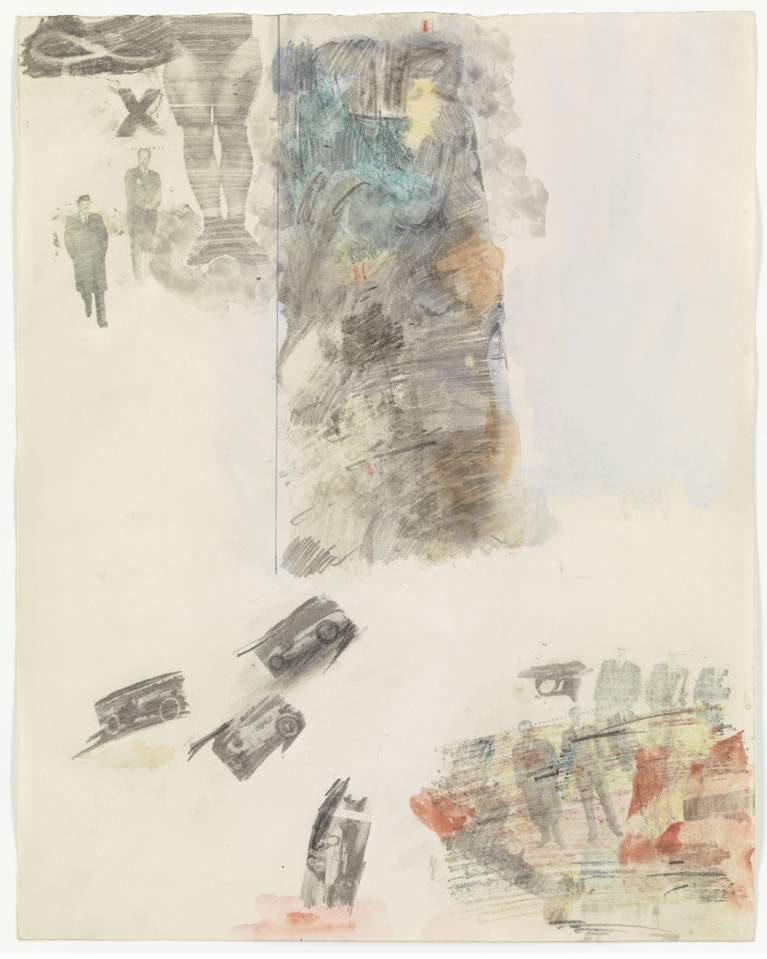
For Krčma, Rauschenberg crafts an American Inferno populated by the faces of modern power.Yet, I’m less interested in endorsing his political stance but in focusing on how quickly institutions can get corrupted.
This feels eerily contemporary with algorithmic feeds, AI, deepfakes, and targeted disinformation campaigns. We live in an age where democracies are failing, with regimes like Venezuela offering a clear example of how institutions collapse. As a Venezuelan lawyer with over five years of experience in U.S. business immigration, now based in New York, I can’t look at Rauschenberg’s Inferno without seeing the immigration system in it. Hell are lives suspended in files and backlogs. I think of Venezuelans who have built legal lives in the United States and now find themselves trapped by the current ban. On one hand, many of us are deeply grateful that President Trump captured the dictator Nicolas Maduro and his wife Cilia Flores on January 3rd. Nevertheless, the regime is still in place while María Corina Machado is fighting for change from abroad.
Meanwhile people here are stuck in a kind of limbo as they cannot safely return to Venezuela, but they also cannot move forward in the U.S. Under the new restrictions, even Venezuelans who have spent hundreds of thousands of dollars in a U.S. education, who hold valid work visas, green cards, or clear paths to naturalization can suddenly find their processes paused. You can have a job, a home, children in school, a marriage built here, but your renewal, your adjustment, your citizenship application must wait indefinitely.
These holds stem from a USCIS policy memorandum issued December 2, 2025, which pauses processing of all pending immigration benefits for citizens of 19 countries listed in the June 2025 travel ban. It also orders re-review of already approved benefits for anyone from those countries who entered the U.S. after January 20, 2021, and halts all asylum applications regardless of nationality. Nearly 200 individuals have filed Doe v. Trump, 25-cv-13946 (D. Mass.), challenging this policy. On March 14, 2026, the U.S. embassy reopened in Caracas, the American flag raised for the first time in 7 years. Could this potentially be signaling Venezuela’s removal from the list? We wait to see if the courts, this diplomatic breakthrough, or improving relations will open a passage through this Inferno.
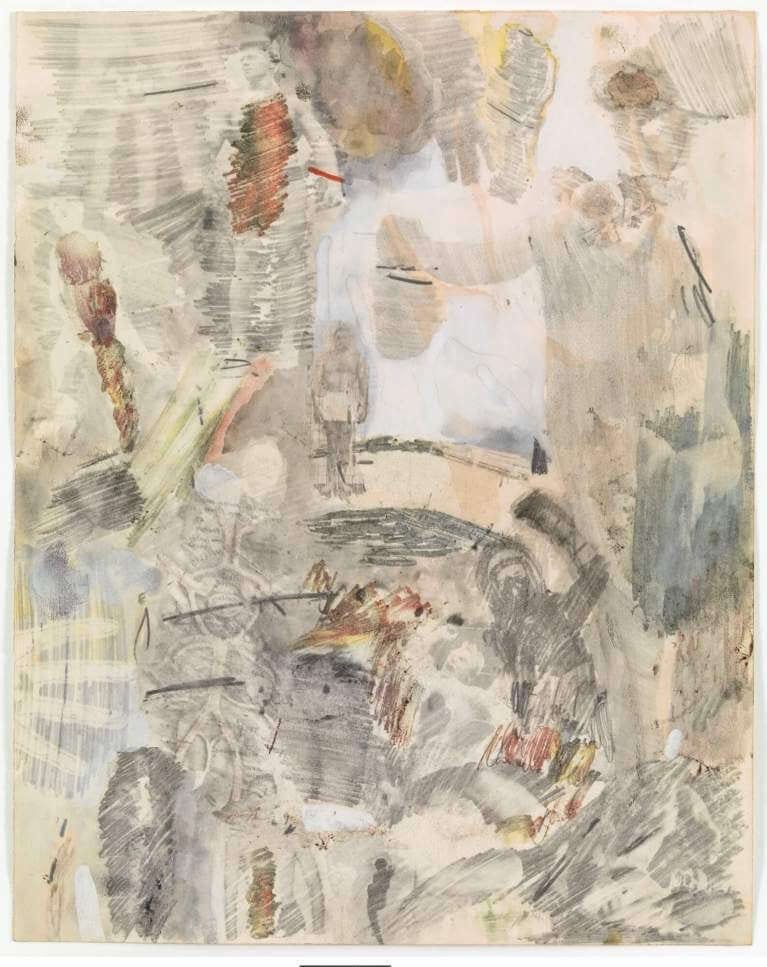
Dante wrote as an exile, wandering through imagined landscapes to make sense of a political and personal catastrophe. Rauschenberg, working centuries later, inhabited a different kind of marginality as a queer artist in a homophobic culture. In different ways they both understood that to lose one’s place in the world.
To write, to draw, to guide someone through a legal labyrinth of migration, is to perform a similar act of translation. You take chaos (a dictatorship, grief, bureaucracy, relocation) and try to reassemble it into a narrative that can be recognized by the law.
Dante’s Inferno ends with the climb out of Hell, Rauschenberg’s drawings capture the darkness but point toward light. For Venezuelans suspended between a regime that will not fall and a system that will not move, persistence becomes the climb towards the light.
Until next week!
Sources
The Museum of Modern Art (MoMA). Robert Rauschenberg: Thirty-Four Illustrations for Dante’s Inferno.
https://www.moma.org/collection/works/series/36719[moma]Krčma, Ed. Robert Rauschenberg. London: Tate Publishing, 2016.
https://archive.org/details/robertrauschenbe0000krcm/page/4/mode/2upThe Robert Rauschenberg Foundation. “Solvent Transfer Drawings.”
https://rauschenbergfoundation.org/art/galleries/series/dante-drawings-1958-60Dante Alighieri. The Divine Comedy: Inferno. Translated by John Ciardi. New American Library, 1954.
https://archive.org/details/inferno_202106/page/84/mode/2upThe White House. “Restricting the Entry of Foreign Nationals To Protect the United States From Foreign Terrorists and Other National Security and Public Safety Threats” June 4, 2025 https://www.whitehouse.gov/presidential-actions/2025/06/restricting-the-entry-of-foreign-nationals-to-protect-the-united-states-from-foreign-terrorists-and-other-national-security-and-public-safety-threats/
The White House. “Restricting the Entry of Foreign Nationals To Protect the United States From Foreign Terrorists and Other National Security and Public Safety Threats” Dec. 16, 2025 https://www.whitehouse.gov/presidential-actions/2025/12/restricting-and-limiting-the-entry-of-foreign-nationals-to-protect-the-security-of-the-united-states/
Fragomen. “United States: USCIS Takes Restrictive Action on Pending and Approved Immigration Benefits for Many Foreign Nationals.” 2026. https://www.fragomen.com/insights/united-states-uscis-takes-restrictive-action-on-pending-and-approved-immigration-benefits-for-many-foreign-nationals.html
Fragomen. “United States: USCIS Expands and Clarifies Adjudication Policies Applied to Foreign Nationals from Travel Ban Countries” 2026.
Fox News. "American flag raised, flies over US Embassy building in Venezuela for first time in 7 years." March 14, 2026.
https://www.foxnews.com/world/american-flag-raised-flies-us-embassy-venezuela-building-first-time-7-years