Three New Restaurants to Try This Summer in New York
2026-08-11 · 4 min read
My dearest incurable humanist, One of the many things I love about living in New York is the food. But beyond the obvious, food has always interested me as a story of migration. The tomato for instance feels inseparable from Italian cuisine; Caprese salads, pizza, and pasta sauce… Yet it came from…
My dearest incurable humanist,
One of the many things I love about living in New York is the food. But beyond the obvious, food has always interested me as a story of migration. The tomato for instance feels inseparable from Italian cuisine; Caprese salads, pizza, and pasta sauce… Yet it came from Mesoamerica and was later taken to Europe during the conquest. You see? much of what we think of as native to a place is, in fact, the product of movement and exchange.
New York’s food scene is one of the clearest examples. Its culinary identity comes from Chinese, Italian, Irish, Korean, Dominican, Puerto Rican, Indian, Polish, and countless other nationalities. Over time, these traditions have transformed one another, producing foods that feel so “New York”; like the slice pizza, the bodega sandwich, the bagel with lox, and so much more.
I recently finished Lori Zabar’s book - Zabar’s: A Family Story, with Recipes, which traces the origins of this Manhattan staple. The story begins with Louis Zabar’s childhood in Ostropolia, a town that was then part of Russia and is now in Ukraine. After surviving a devastating pogrom in 1920, Louis fled to New York, where he reunited with Lilly Teitelbaum, whom he had known back home. They married and, in 1934, opened a modest smoked-fish and delicatessen counter at Broadway and 80th Street.
As such, Zabar’s belongs to a larger history of New York deli culture, the German-style delicatessens arrived in the nineteenth century, then were remade by Yiddish-speaking Jewish immigrants, whose cooking, religious practices, and appetite for foods like smoked fish, herring, and bagels shaped the city’s culinary landscape. Zabar’s is “kosher-style,” rather than strictly kosher, but its identity grew from that Jewish food tradition. Today, it is hard to imagine the Upper West Side, or New York, without Zabar’s.
A city becomes cosmopolitan because of stories like this, where different cultures meet. This summer, three openings in Manhattan have made me think about that ongoing story.

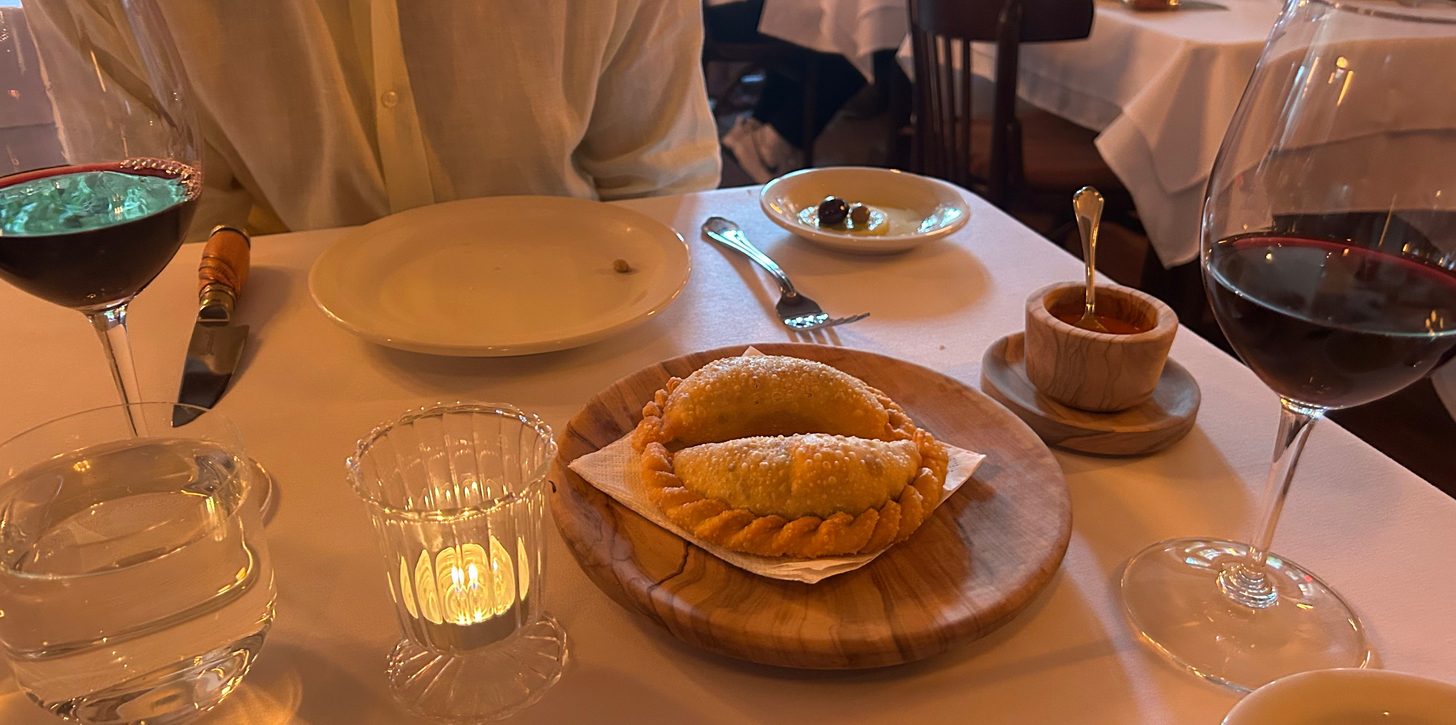
Graciela is the new Argentine restaurant from Pablo Rivero the restaurateur behind Buenos Aires’s highly acclaimed Don Julio. It draws on the spirit of the bodegón, a convivial gathering place built around generous food, good wine, and the pleasure of lingering at the table. Its cooking is centered on live fire, with a traditional parrilla and Josper oven at its heart. I went during opening week and loved it! The steak was superb, as one would hope, but I was especially taken with the pimientos asados and the empanadas. What stayed with me most was the hospitality. The sommelier took time with our table, and Pablo came over to say hello. If you’re looking for a new date night spot, this should be it!
ROSSA is a new Mexican café in Koreatown that I have not yet visited, but I am very much looking forward to trying, especially because it is close(ish) to my office. Founded by Nicolás Salas, who spent more than four decades running small restaurants and pizzerias in Mexico, it is his first venture in New York. The menu includes conchas, churros, quesadillas, and drinks like a tres leches latte and the Café Pendejo, a spicy coffee with a chile-pepper kick inspired by Mexican truckers. I can’t eat dairy, so I will have to see what I can find, but I will keep you posted!
Flatiron is welcoming Taquería El Califa de León at the end of August, bringing a piece of Mexico City’s culinary history to New York. I have eaten at El Califa de León in Mexico City, which is why I am so excited for its arrival. The original taquería is a modest, cash-only spot in the Cuauhtémoc neighborhood, known mostly to locals. In 2024, Michelin awarded it a star becoming the first taquería to receive one, and immediately entered the ‘fine dining’ scene, becoming one of the top spots to eat in the city for tourists and connoisseurs.
I hope you get the chance to visit one of these spots this summer, and that the next time you sit down to eat, you think about how many borders that recipe crossed.
Until next week!