Venezuela Earthquake 2026: Grief, Collapse, and the Cost of a Broken State
2026-06-29 · 6 min read
My dearest incurable humanist, It is with great sadness that I write to you today. Although I usually write to you on Tuesdays, I am publishing this week’s newsletter on Sunday because of what has happened. Last Wednesday, June 24, two earthquakes measuring 7.2 and 7.5 in magnitude struck…
My dearest incurable humanist,
It is with great sadness that I write to you today. Although I usually write to you on Tuesdays, I am publishing this week’s newsletter on Sunday because of what has happened. Last Wednesday, June 24, two earthquakes measuring 7.2 and 7.5 in magnitude struck Venezuela, leaving behind devastation that is still unfolding.
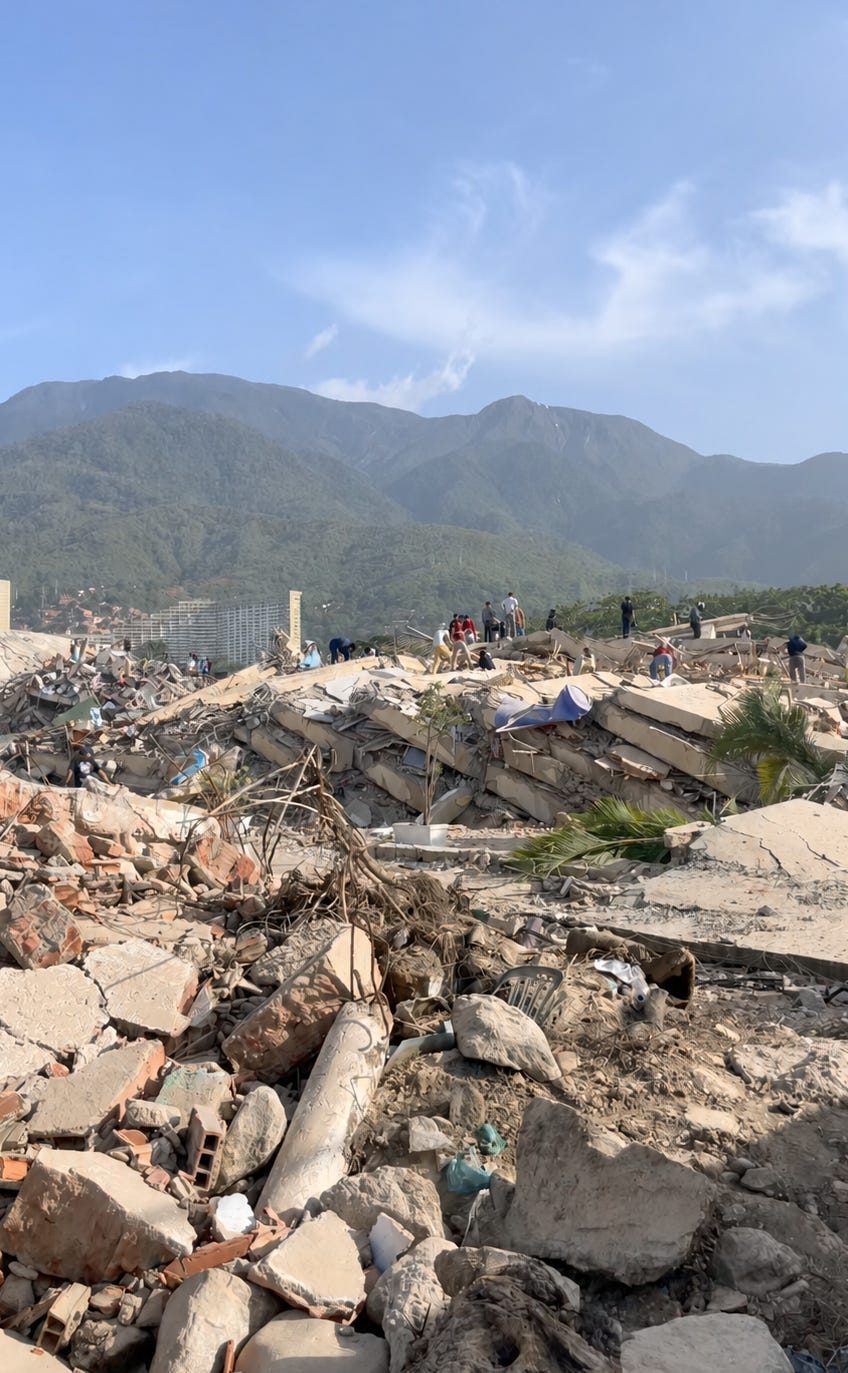
As we watched the news, we realized that one of the hardest-hit areas in Caracas was my in-laws’ neighborhood. We called again and again, but communications had collapsed. My husband and I sat staring at each other, unable to speak. I could not stop thinking about what it would mean for him to lose his parents without even having the chance to say goodbye. Hours later, we finally reached them. They were alive. Their apartment had cracked, but the building was still standing. They were frightened, but safe. I thought this would feel like relief. And in some ways it did. But relief does not cancel grief. Because while our family was spared, countless others were not.
As of this writing, at least 1,400 people are reported dead, with more than 51,000 still missing as rescue efforts continue. Across the country, buildings have collapsed. Entire neighborhoods have been reduced to rubble. Families wait outside piles of concrete for days, hoping someone they love will be pulled out.
A natural disaster is catastrophic anywhere. In Venezuela, it lands on a country already hollowed out by a humanitarian crisis. The earthquake is one layer yet, the rest was already there.
If you have never been to Venezuela, you may not understand why La Guaira (formerly Vargas state) occupies so many headlines, and so many broken hearts. It is the coastal state that connects Caracas to the Caribbean. It is home to the country’s principal international airport and its most important port. Simón Bolívar International Airport (Maiquetia) has become part of the farewell for the nearly eight million Venezuelans who have left the country, a place where leaving was already a kind of mourning. Seeing it damaged is devastating because it feels as if even the memory of return has been shattered, as if exile has not only taken us away but also erased the path back.
La Guaira also bears the memory of another catastrophe. In December 1999, after days of torrential rain, landslides swept down the mountains and buried entire towns beneath mud and rock. Thousands were killed, and tens of thousands were left without homes, livelihoods, or certainty. That devastation became known as La Tragedia de Vargas, one of the worst natural disasters in Latin American history.
Many of the families now digging through rubble are the same families, or the children and grandchildren of those who rebuilt after that catastrophe. They rebuilt what they could, reopened their businesses, and stayed in a place that never truly recovered. After the Vargas tragedy, Venezuela had an opportunity to rebuild differently; to enforce building standards, strengthen infrastructure, and develop emergency systems capable of protecting its people. Instead, those possibilities were squandered. Twenty-seven years later, La Guaira is once again burying its dead. For Venezuelans, this is the anguish of watching a community that has already survived the unimaginable being forced to survive it all over again.
Millions of children live in the affected areas. Many have lost, or have been separated from, their families in the chaos. Humanitarian organizations have long warned that children separated from their caregivers after disasters face a sharply increased risk of exploitation and human trafficking. Venezuela has already lived through this nightmare. After the Vargas tragedy, children disappeared amid the confusion, and families spent years searching for them. Some were never reunited. We cannot allow history to repeat itself. What is urgently needed is immediate protection for these children. But the regime is doing nothing.
The earthquake exposed Venezuela’s vulnerability. Three days after the earthquakes, people were still digging through concrete with their bare hands. Volunteers arrived carrying their own shovels. Hospitals are treating patients outdoors, not because of the earthquake alone, but because for years they have lacked medicine, electricity, supplies, and functioning equipment.
These conditions are the result of decades of corruption, neglect, and the systematic dismantling of institutions. Figures like Delcy Rodríguez, who today stand at the center of state power, represent a system that has prioritized control over capacity, propaganda over preparedness. I know some will say that tragedies should not become political. But there is no honest way to separate this disaster from the regime. Where is the army that has spent over two decades repressing its own people? (For more on how Venezuela reached this point, I wrote about it here.)
And yet, in the absence of a functioning state, my friends back home have spent the past several days organizing donations, verifying missing-person reports, collecting medicine, cooking meals, opening shelters, and showing up wherever another pair of hands is needed. These are the true heroes. Long before officials arrived with cameras, civilians were already rescuing one another.
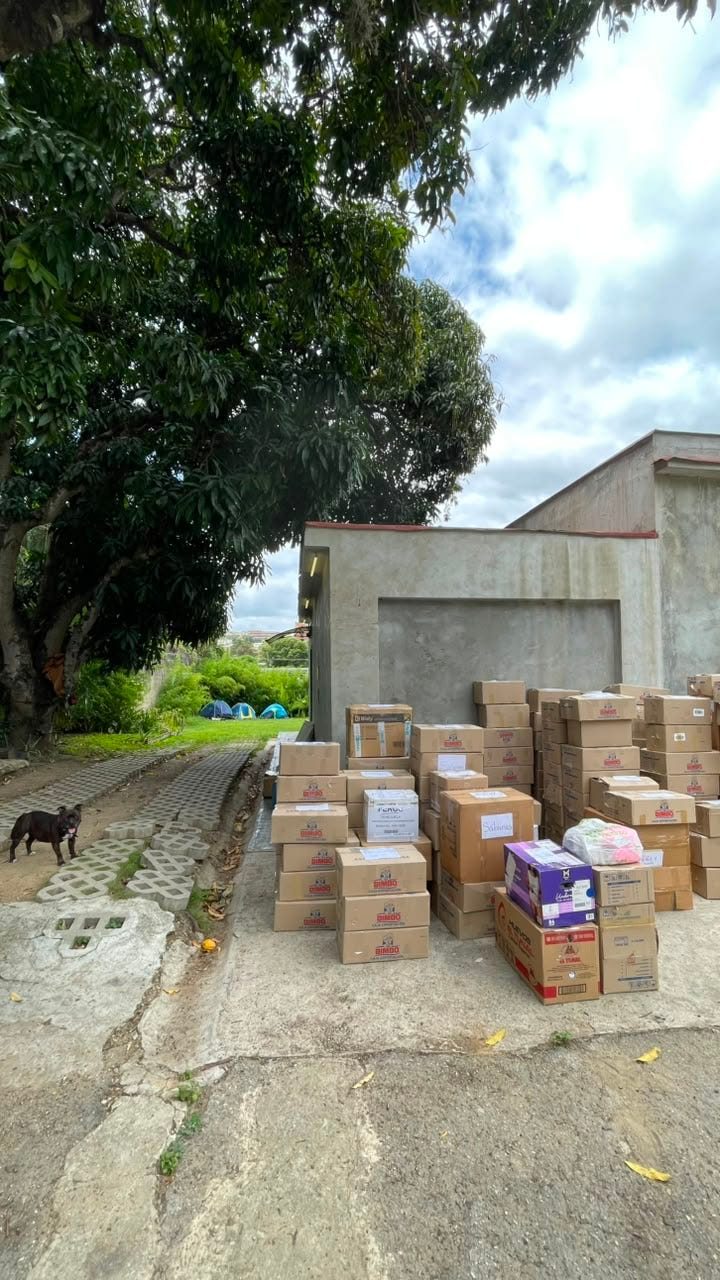
Acting President Delcy Rodríguez’s government has kept tight control over access to the hardest-hit areas. In spite of this, people have mobilized quickly, sending food, medicine, rescue equipment, and money from inside Venezuela and abroad. Yet that has too often run up against state control, slowing what should have been a faster, freer response. Still, Venezuelans have found ways to help one another, as they always do when the state fails us.
At last, international help has begun to arrive, a reminder that Venezuela’s own rescue capacity has been hollowed out by years of neglect and collapse. Countries have pledged support, including rescue teams, medical supplies, and emergency aid from the United States, Colombia, Mexico, Chile, Spain, and the United Nations, among others.
Since Wednesday, I’ve been glued to my phone, watching from afar in heartbreak. It has been so hard to concentrate at work or go on with daily life as if nothing has happened, while my country, my family, and my friends are living through this. It is a feeling I share with the more than seven million Venezuelans who are not there, but who are carrying this pain.
Why is my country always breaking? Will it ever rebuild? I keep asking myself as I refresh my phone. There is a particular helplessness in watching from afar, in knowing that the people you love are living through something you cannot reach, cannot fix. And yet, even from here, I refuse to look away. To bear witness is, in its own small way, a form of presence. Venezuela is hurting but it is not alone, not entirely, not if those of us scattered across the world continue to remember, to speak, to insist that these lives, these losses, matter. If resilience has become our inheritance, then so too must responsibility to each other, to the truth, and to the possibility (however distant) of a free and stable country.
If you want to help, these are reliable ways to donate:
I Love Venezuela Foundation + We Love Foundation
ImpaKtemos (Zelle: imaktemos@impaktemos.org - IMPKTEMOS LLC)